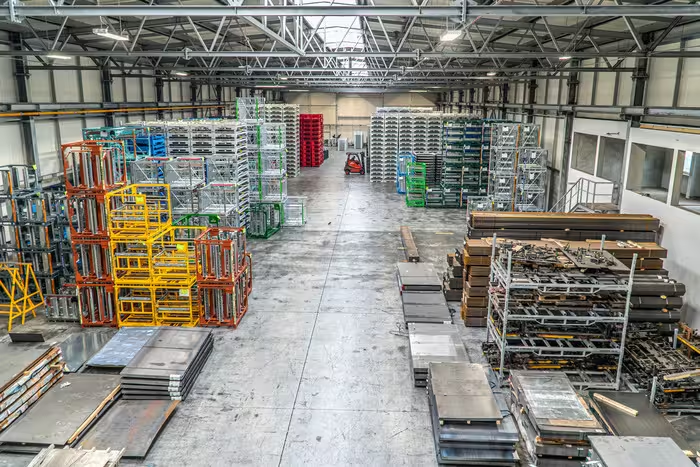
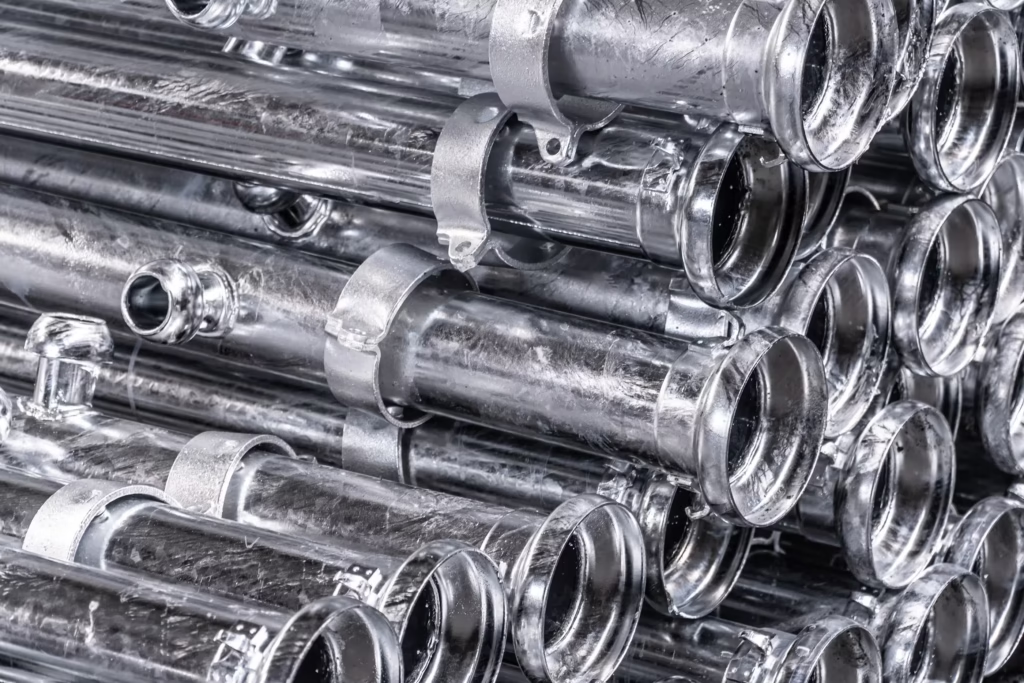
For years, Silesia has set the pace for industrial development in Poland. It's a region where steel structures, machine components, and technical infrastructure operate in conditions requiring durable and proven anti-corrosion protection. It is in this environment that we develop Strumet, meeting the needs of production plants and companies for whom coating quality is directly important in daily operations.
An important stage in the development of Strumet was the launch of a new plant in mid-2020. galvanic galvanizing plant. This was a decision to invest in technology that provides control over the galvanizing process and allows for achieving stable, repeatable coating parameters. We designed the galvanizing plant from the ground up, with automation, parameter control, and high efficiency in mind, which translates into the quality of services provided today. Operating in the heart of Silesia, we operate in an environment where durability and reliability are the daily standard of work, not additional requirements. We develop our own technologies, invest in modern infrastructure, and rely on laboratory facilities that allow us to control the entire process.
What exactly is galvanization and what does the process involve?
Galvanization is electrochemical process, in which a thin layer of another metal is deposited on the metal surface from an electrolyte solution. The element to be coated acts as cathodes, and the metal ions present in the bath are deposited on its surface when a voltage is applied. As a result, consistent coating, which gives the detail specific functional properties.
In practice, electroplating isn't just about immersing the part in a bath. Each step and each parameter influences the behavior of the deposit. Current density, temperature, bath pH, its chemical composition, and the geometry of the part determine whether the coating will be even and stable, whether there will be any unevenness or areas susceptible to wear. This process quickly reveals inaccuracies in surface preparation, which remain invisible in the earlier stages of production.
Technological facilities – how is our electroplating plant in Silesia equipped?
Our electroplating plant was designed as a system in which automation and parameter control are the basis of process stability. We operate on two production lines that enable us to process a wide range of components.
The suspension line allows for galvanizing larger structural elements with dimensions up to 2.8 m long, 0.8 m wide and 1.8 m high. This enables uniform coating deposition on components with complex geometries, without localized over- or under-plating. The drum line is designed for small, serial parts. Components such as screws, nuts, and technical components are processed in a way that combines high efficiency with consistent coating thickness throughout the entire batch.
Transport between the tubs is automatic, and computer systems monitor bathing parameters in real time. Their stability is monitored by chemists working in our own analytical laboratory. This element of our technological base allows us to maintain a consistent process, regardless of production volume.
Coating stages – from preparation to passivation
We start each galvanic process with surface preparation, because it is at this stage that the quality of the entire coating is determined. This is where we determine whether the zinc will deposit evenly and whether the layer will maintain durable adhesion over the long term. Degreasing removes oils and organic contaminants, pickling eliminates oxides and traces of corrosion, and subsequent rinsing and activation bring the surface to a state where it can properly react with the electrolyte.
Electroplating doesn't mask preparation errors, but rather reveals them very quickly. Even minor remnants of mechanical processing or local contamination translate into reduced adhesion and discontinuity of the deposit. Therefore, we treat surface preparation as an important stage of the process, which has a direct impact on the durability and uniformity of the zinc coating.
Characteristics of zinc coatings – protection and decoration in one
The actual galvanizing is carried out in alkaline electrolyte, in conditions that allow for very precise control of process parameters. The coating thickness is regulated within the range from 3 to 25 µm, controlling the deposition time and current density. This approach allows the protection to be tailored to the actual operating conditions of the component, without unnecessarily increasing the layer thickness. Zinc coatings obtained by the galvanic method are even and smooth, and at the same time do not significantly affect the dimensions of the part. This is particularly important in the case of threaded and precision components, where maintaining assembly tolerances determines the correct operation of the entire system.
Passivation and stabilization of the coating
After galvanizing, we move on to the passivation stage, as this determines how the freshly deposited zinc layer will behave during the initial period of use. Zinc remains chemically active immediately after the process, so passivation allows us to limit its reaction rate with moisture and air and stabilize the coating surface.
At Strumet we work on chromium-free passivations, including solutions based on titanium compounds. We achieve a uniform, durable protective layer that increases the coating's resistance to white corrosion while meeting current environmental requirements. Passivation also affects the surface's appearance. The coating maintains an even color and is less susceptible to discoloration during storage or transport. Furthermore, this method prepares the components for further use, assembly, or potential painting, without compromising the adhesion of subsequent layers.
Eko Strumet – why is our electroplating plant in Silesia environmentally friendly?
At Strumet, we have been developing galvanizing and electroplating technologies for many years in such a way that they are process-stable and as environmentally friendly as possible. Already in 2008, with the launch of the hot-dip galvanizing plant, we assumed that coating durability and environmental responsibility must go hand in hand. We are consistently developing this approach in the galvanizing plant as well. We conduct processes in installations designed to operate in closed circuits. Both the galvanizing plant and the hot-dip galvanizing plant are sewage-free, and the technological solutions operate in a closed system, supported by its own treatment plant. The process tanks are located in sealed chambers, from which vapors are captured and purified in absorbers. The entire system operates under constant supervision, and emissions are monitored continuously.
We cover part of the plant's energy needs from photovoltaic installation, and in the hot dip galvanizing plant we use heat recovery. In our daily work, we use solutions that reduce raw material consumption and waste, such as laser cutting, waste sorting and recycling, and reusable consumables. This technology has allowed us to protect steel structures with durable zinc coatings for years., without simplifying the process and without transferring environmental costs to the surroundings.
Why the Strumet electroplating plant offers a real technological advantage
At Strumet, we perform galvanization and zinc plating based on modern technological facilities, team experience and full process control. We work on automated lines, utilize our own laboratory, and ensure stable parameters, which allows us to maintain consistent quality and short lead times. We analyze each order individually, taking into account the material, component geometry, and its subsequent operating conditions. The electroplating plant in Silesia in Strumet choose companies that expect a specific technological effect and stable coating parameters, and not just formal metal protection.
If you would like to discuss details or get a quote, please call +48 539 006 374 or write to [email protected] – we will answer specifically and factually.