From the First Sparks of Automation to the Cobots of the Future - How Did Industrial Robots Become a Pillar of Modern Industry?
Today, a few words on how engineers created machines capable of driving a welding arc on their own with unprecedented precision. From Unimate at General Motors to intelligent arms that now work side by side with humans.
Today's robotic welding is the result of a multi-stage development of industrial robotics, which built its foundations as early as the 1960s.
The milestone is considered to be 1961, when the first industrial robot, Unimate, designed by George Devol and Joseph Engelberger, appeared in a General Motors factory. It did not weld yet, but it successfully moved hot and heavy castings, eliminating the most dangerous stages of human work.
The real breakthrough for welding came only in the 1980s, when, thanks to the development of CNC controllers, seam-tracking sensors, and more flexible kinematic systems in robot arms, it became possible to achieve the precision and repeatability required for joining metal.
Paradoxically, although the idea of automation had been around much earlier, it was only progress in control systems that made it possible to robotize welding processes on a mass scale.
One of the biggest users of welding robots has always been the automotive industry - from Toyota to Ford. Their robotic spot welding lines are still regarded as a benchmark of efficiency.
The Polish Chapter of the Story - from Enameled Bathtubs to the Polonez
Meanwhile, in Poland, work on designing domestic industrial robots began in the early 1970s. As early as 1976, several pioneering stations were set up at research centers such as the Industrial Institute of Automation and Measurements, the Precision Mechanics Institute in Warsaw, and the Machine Tool Research and Design Center in Pruszków.
The first successful example of using robots in domestic industry was the robotic enameling of bathtubs and sinks at the Olkusz Enamelware Factory - machines from DeVilbiss-Tallfa (today's ABB) were used there.
An even more interesting example was FSO, where 15 Unimation robots were installed on the Polonez body assembly line, performing 384 of the 1,995 spot welds. It was a technological leap for those times - a real example that Poland was not lagging far behind global trends.
Where Are Robots Today?
Industrial robots, including welding robots, have always been created to replace humans in work that is exceptionally burdensome, dangerous, or requires superhuman precision. They are increasingly used in the production of steel structures, household appliances, agricultural machinery, and rolling stock.
Welding robots can be divided into several main types, depending on the technology used and the application. The most popular are robots for arc welding, which, thanks to precise guidance of the electric arc, are responsible for most automated joints in the steel and automotive industries. Robots for resistance welding are also widely used, ideal for joining thin sheets in the production of car bodies or household appliances - this process requires no additional filler metal and provides high efficiency.
Among specialized solutions, robots for TIG welding and MIG/MAG stand out, which differ in the type of electrode and shielding gas, and therefore in their range of applications - from pressure vessels, through aluminum parts, to steel structures. Increasingly important are robots for laser welding, valued for exceptional precision and minimal material distortion - they are used, among others, in the automotive and aviation industries. A specialized group also includes robots for plasma welding, which prove their worth where it is necessary to join refractory materials or materials sensitive to high temperatures, such as titanium or nickel.
From Stationary Giants to Cobots
Thanks to modern solutions such as cobots - that is, collaborative welding robots - automation now reaches not only large halls but also medium-sized and small plants. Modular, mobile, often portable arms can work side by side with humans, increasing safety, efficiency, and weld quality without the need for gigantic investments.
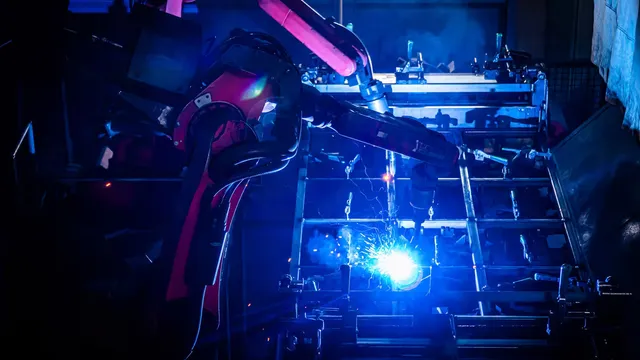
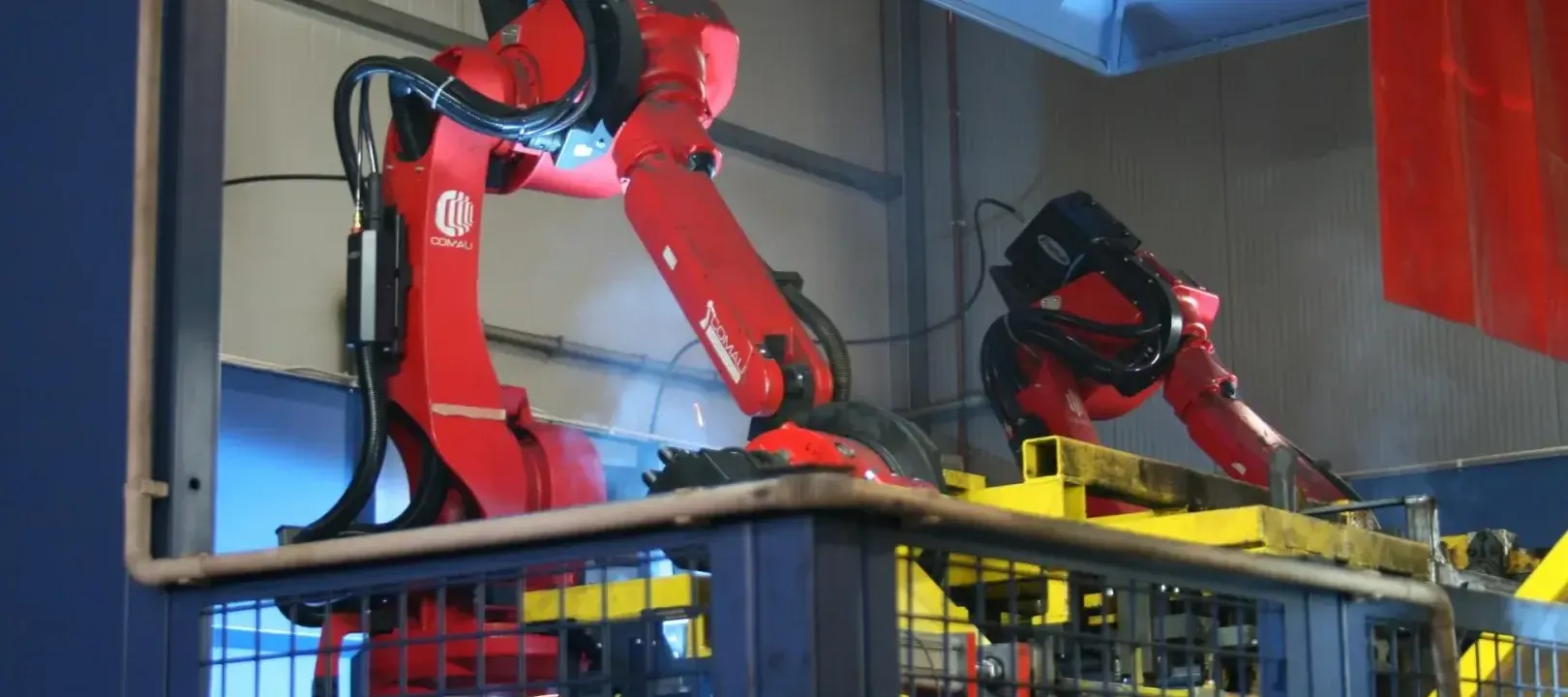
At Strumet we also combine tradition with modernity. We have 11 robotic welding stations, including:
- dual robots with two rotary tables,
- single robots with two fixed or rotary tables,
- welding equipment dedicated to larger and smaller steel components.
Each of our welding robots is based on reliable power sources Fronius TPS4000, TPS400i or MERKLE, which ensures high-quality MIG/MAG welds - for carbon steels, chromium-nickel steels, and aluminum alike. This allows us to carry out processes on components measuring up to 3300 x 1300 mm, with two arms working simultaneously!
What is more, behind all of the robotization stands a team of 100 qualified Strumet welders, certified in accordance with ISO 9606-1, supervised by a chief welding coordinator holding the qualifications IWE, IWI-C, IWT, IWP and the VT, PT, MT, UT-2 certifications. This means that the robot welds, but a human keeps watch - guaranteeing the highest quality, approved by TÜV Rheinland.
Strumet's welding robots are more than machines. They are certified repeatability in accordance with EN 1090 and EN ISO 3834, the solidity of steel structures, and the flexibility to handle both larger orders and short runs.
And what's next? It is possible that before long the sight of a welder in a mask will become history, giving way to robots that never get tired. But what drives them to work still comes from people - and that won't change for a long time…