Galvanized steel is a material that, in practice, determines the durability of the entire structure. We're not talking about a thin decorative coating, but rather a protective technology that modifies the steel's behavior in environments with moisture, fluctuating temperatures, and industrial pollutants. In the case of hot-dip galvanizing, zinc not only coats the surface but also reacts with iron, creating alloy layers. Fe–Zn permanently bonded to the substrate.
Steel corrosion is an electrochemical process that begins immediately upon contact with water and oxygen. In construction, energy, and industrial structures, this translates into reduced load-bearing capacity, aesthetic degradation, and rising maintenance costs. A properly applied zinc coating interrupts this process at the material level, separating the steel from the environment while simultaneously absorbing corrosive reactions at potential damage sites.
With the appropriate coating thickness and taking into account the environmental corrosion class, galvanized steel can operate for 30, 40, or even more than 50 years without the need for renovation. Therefore, in modern construction and industry, it is not a technological addition, but a design standard that influences the entire life cycle of a structure.
What is the steel galvanizing process?
At Strumet, we conduct galvanizing as a conscious technological step in which we protect the steel with a layer of zinc, to effectively protect it from corrosion in atmospheric and industrial environments. We don't treat this as a simple metal coating, but rather as a process that directly impacts the durability, safety, and operating costs of the entire structure.
Depending on the purpose of the element and its operating conditions, we use two main technologies:
- hot-dip galvanizing,
- electrolytic galvanizing.
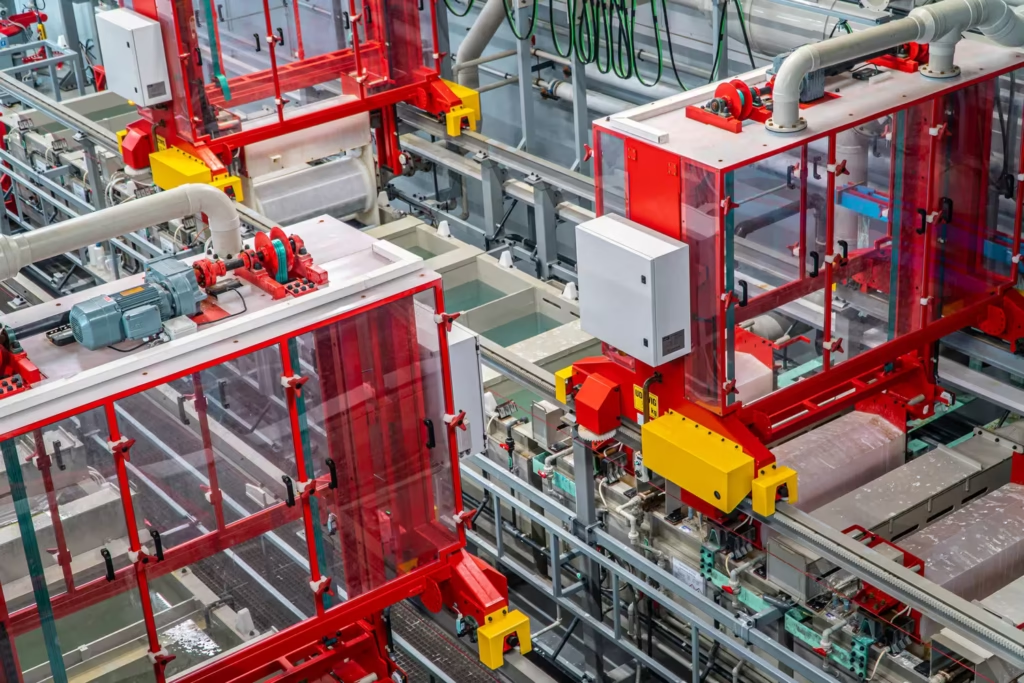
In the case of hot dip galvanizing, we immerse the steel in liquid zinc, which leads to the formation of alloy layers permanently bonded to the substrate. This creates a thick, resistant coating designed for structures operating in demanding environments.
During electrolytic galvanizing, we deposit zinc from the solution using an electric current, which results in a thinner, very even coating, which does not significantly affect the dimensional tolerances of the element.
Each of these methods gives a different effect in terms of coating thickness, structure and corrosion resistance, therefore we always select the technology based on the function that the element is to perform in real working conditions.
Hot-dip galvanizing – durable protection for large structures
In hot dip galvanizing, we immerse the steel in a zinc bath at a temperature 445-455°C. At this temperature, intense diffusion occurs between iron and zinc. The zinc doesn't just remain on the surface—the atoms penetrate the steel structure, creating Fe-Zn alloy layers of varying hardness and composition.
A typical coating structure consists of several layers:
- alloy layers at the base, very hard and abrasion-resistant,
- an outer layer of pure zinc, more plastic, responsible for anodic protection.
The coating thickness in hot-dip galvanizing is most often in the range of 70–150 µm, in accordance with the requirements of the PN-EN ISO 1461 standard. In the case of steel with a specific chemical composition or a greater element thickness, the coating may be even thicker.
The advantage of this method is that the zinc reaches all surfaces of the element – including the interior of closed profiles, technological spaces, and openings. Protection covers the entire cross-section of the structure, not just the visible parts.
We use hot-dip galvanizing for:
- structures of industrial halls,
- bridges and viaducts,
- power poles,
- support systems for industrial installations,
- elements of road and railway infrastructure.
Electrolytic galvanizing – precision for smaller components
In electrolytic galvanizing, zinc is deposited from an electrolyte solution using an electric current. The steel component acts as a cathode, and zinc ions are reduced directly on its surface, creating a compact and controlled layer. The process is performed at temperatures significantly lower than in hot-dip galvanizing, which maintains the component's dimensional stability. The coating thickness is most often in the range of 5–25 µm, and its uniformity means that it does not disturb assembly tolerances or thread geometry.
Electrolytic galvanizing is used primarily for:
- screws and nuts,
- small structural elements,
- technical components where surface aesthetics and precision of workmanship are important.
In moderately aggressive environments, this coating effectively protects steel against corrosion and at the same time allows us to maintain dimensional accuracy of the detail and stability of its technical parameters, which is important for assembly elements and components working in precise systems.
Why galvanized steel is corrosion resistant
Resistance galvanized steel It is based on two mechanisms that work simultaneously and complement each other, so that the protection is not limited to the surface separation of the metal from the environment.
The first one is physical barrier, because the continuous zinc layer effectively isolates the steel from moisture, oxygen and industrial pollutants, thus limiting the possibility of initiating corrosive reactions. The second mechanism is cathodic protection, resulting from the fact that zinc has a lower electrochemical potential than iron, therefore in the event of damage to the coating, zinc reacts first and takes over the oxidation process.
Consequently, even a local scratch does not lead to the immediate development of steel corrosion, because zinc corrosion products, mainly oxides and carbonates, gradually fill the resulting gap, limiting further access of moisture and oxygen to the substrate, which significantly extends the durability of the entire structural element.
Does galvanized steel rust and how long does it last?
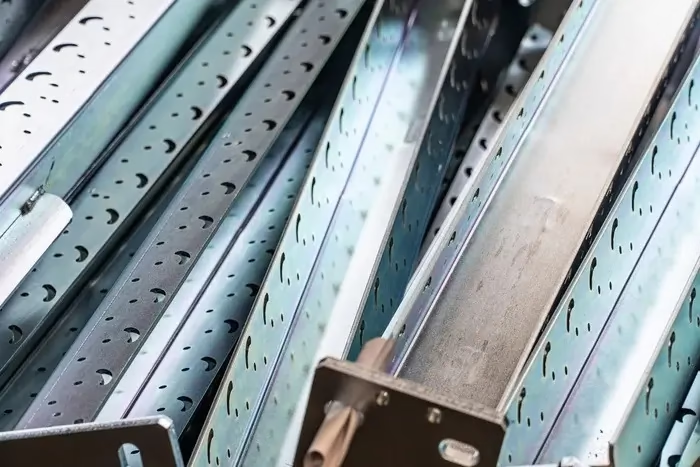
A freshly galvanized surface has a bright, metallic sheen. Depending on the steel composition and process conditions, it may be more gray and dull. Upon exposure to air, the coating gradually dulls. A stable protective layer composed of zinc oxides and carbonates forms on its surface. This color change does not indicate a deterioration in quality, but rather a natural stage in the coating's maturation.
The rate of zinc depletion depends on the environmental corrosivity class. According to PN-EN ISO 12944, classes C1 to C5 are distinguished. In a moderate environment, zinc depletion can be approximately 1–2 µm per year. This means that a 100 µm thick coating can last for several decades.
In industrial or marine environments, the rate of wear is higher, but a properly selected coating thickness still allows for long-term durability. It is this predictable degradation, involving the gradual depletion of zinc, that makes galvanized steel a long-term solution.
The use of galvanized steel in various industries
We use galvanized steel in many industries where structures must operate stably for years:
- structural and infrastructure construction,
- energy industry,
- automotive,
- agriculture,
- machinery industry,
- telecommunications systems.
In each of these industries, components are exposed to moisture, temperature fluctuations, salinity, or industrial pollution. The zinc layer creates a protective barrier and simultaneously acts electrochemically, so galvanized steel maintains durability even in environments with increased corrosiveness.
How to care for galvanized steel so it lasts for decades
Galvanized steel does not require complicated maintenance, but its durability depends on regular inspection and careful use. In practice, periodic surface inspection and removal of residual contaminants such as road salt, industrial sediments, or mud, which can accelerate the wear of the zinc layer, are sufficient. Cleaning should be carried out using water and mild, pH-neutral cleaning agents, avoiding aggressive chemicals and hard abrasive tools. In highly corrosive environments, it is worth considering a system. duplex, where the paint provides an additional barrier and the zinc coating still provides electrochemical protection.
At Strumet, we emphasize that the quality of the galvanizing itself and the appropriate coating thickness are crucial, as they largely determine whether the structure will operate without problems for decades.
The process of creating a zinc coating – from the bath to the finished product
In hot dip galvanizing, we immerse the elements in molten zinc at a temperature of 445-455°C. Contact between steel and liquid metal triggers intense diffusion, causing zinc atoms to penetrate the iron structure.
This process is very quick, but its effect depends on several parameters that we at Strumet control at every stage. Immersion time, bath temperature and chemical composition of the steel determine the coating's thickness and structure. Longer immersion times and higher temperatures promote more intense growth of the alloy layers, while shorter immersion times produce a thinner, more uniform coating. Unlike mechanically applied coatings, hot-dip galvanizing creates a layer that is permanently bonded to the steel. The coating does not flake or detach, and maintains its integrity even in areas exposed to mechanical stress.
Layered structure of the zinc coating - structure under a microscope
The zinc coating is not uniform. Under a microscope, it is clearly visible several characteristic iron-zinc alloy layers, which grow from the steel side towards the outer surface. The deepest alloy layers are characterized by high hardness, often exceeding the hardness of the steel itself. They are responsible for resistance to abrasion and mechanical damage. The outer layer, composed mainly of pure zinc, remains more plastic and takes on the role of electrochemical protection. This arrangement ensures that the zinc coating retains its ability to shock absorption in the outer layer, while at the same time high mechanical resistance of alloy layers. In practice, this means good resistance to damage during transport and installation, as well as stable coating performance under long-term operating conditions exposed to moisture, temperature fluctuations, and atmospheric factors.
Appearance of zinc coating – why is zinc coating matte or shiny?
Freshly galvanized, the zinc coating usually has bright, metallic shine. Depending on the steel grade, silicon content, and bath temperature, the surface may take on a grayer, more matte shade. This change in appearance does not indicate a deterioration in quality. On the contrary, in many cases, a matte coating is associated with more intensive development of alloy layers. Over time, the coating naturally ages and gradually dulls upon exposure to air, developing a stable, protective patina.
The change in color does not negatively affect the anti-corrosion properties, and in practice it often indicates that the reaction between zinc and steel is proceeding correctly.
Factors influencing the thickness and quality of the zinc coating
The final effect of galvanizing is influenced by many elements, which we analyze already at the stage of accepting the structure into the process. Chemical composition of steel, including the content of silicon and phosphorus, has a direct influence on the rate of growth of alloy layers.
It is also important surface roughness, obtained during mechanical preparation. A surface that is too smooth limits the initiation of diffusion, while an excessively uneven surface promotes uncontrolled coating growth. The bath temperature and immersion time allow for conscious control of the coating thickness, adapted to the component's intended use and its subsequent operating conditions.
The influence of silicon on galvanizing – the Sandelin effect
A special case is steel with increased silicon content. Within a certain concentration range, so-called. Sandelin effect, in which the reaction between zinc and iron is extremely intense. In practice, this leads to the formation of very thick, gray and uneven coating, which, despite its high mass, can exhibit greater brittleness. For this reason, at Strumet, we always analyze the chemical composition of the steel and adjust process parameters to limit the undesirable effects of excessive diffusion.
High-temperature galvanizing and standard galvanizing – differences in technology
Standard hot dip galvanizing is carried out at temperatures of approximately 445-455°C. For specific components, such as screws, nuts, or precision parts, we use high-temperature galvanizing, reaching about 560°C. Higher temperature accelerates the diffusion reaction and allows to obtain controlled coating thickness while maintaining appropriate assembly tolerances. The coating obtained in this process typically has a more matte appearance and a different layer structure.
Electrochemical protection – what happens when the coating is scratched?
One of the greatest advantages of zinc coating remains cathodic protection. In case of local damage zinc coating Zinc reacts faster than steel and takes over the corrosion process. As a result, the steel remains protected, even when the coating is mechanically damaged. Over time, zinc corrosion products fill the crack and restrict the access of moisture and oxygen, slowing further deterioration of the material and allowing the coating to maintain its protective properties.
Resistance to mechanical damage – hardness of layers
The zinc coating copes well with mechanical loads thanks to its layered structure. The outer zinc layer absorbs the energy of impacts and minor deformations, and internal Fe-Zn alloy layers They are characterized by very high hardness, often greater than that of structural steel. In practice, this means that the coating does not crack upon impact and effectively protects the steel from deeper damage.
Durability of the zinc coating and corrosion class
In moderate environmental conditions, the zinc coating retains its properties for 30-50 years, and even longer in favorable conditions. The rate of its wear depends on the environmental corrosivity class in accordance with the PN-EN ISO 12944 standard.
In environments C4, characteristic for industrial areas, and in classes C5-I and C5-M, covering aggressive and marine atmospheres, appropriately selected coating thickness allows for long service life without the need for additional protection.
PN-EN ISO 1461 standard – how to measure coating thickness?
The thickness of the zinc coating is measured in micrometers, most often using non-destructive methods. The PN-EN ISO 1461 standard specifies minimum thickness values depending on the steel thickness and the type of element. Typical coatings fall within the range 70-150 µm, which provides effective protection in most structural applications.
The most common coating defects and design errors
Problems with the quality of the coating most often result from design errors. Improper venting, closed spaces, or paint and welding spray residue can lead to local defects. These types of defects cannot always be eliminated during the process, so it's important to consider hot-dip galvanizing requirements during the design phase.
Repairing damaged zinc coating – principles and methods
Minor damage to the coating can be repaired in accordance with standards, provided the area does not exceed specified values. In such cases, we use zinc-rich paints, spray metallization or zinc solders, while maintaining the required thickness of the repair layer.
Painting galvanized steel
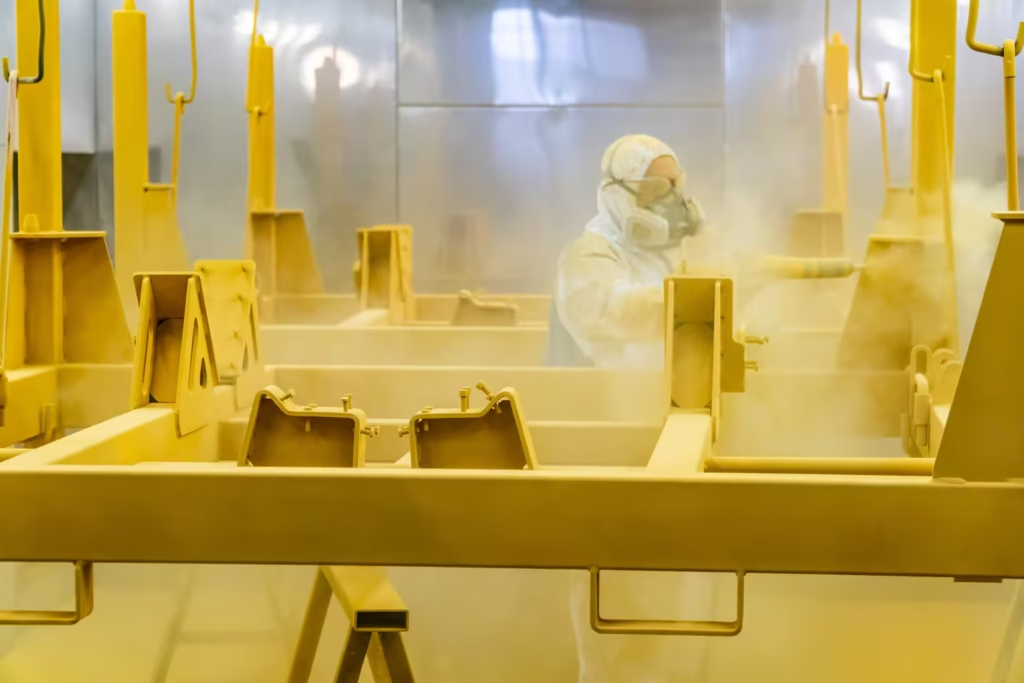
We can easily combine galvanizing with painting, creating duplex system, which significantly increases the durability of the protection. The paint limits the access of moisture and oxygen to the surface, and the zinc coating also protects the steel under the paint layer, even where minor damage occurs. In practice, this allows us to significantly extend the life of the structure, while also giving it a specific color and aesthetic tailored to the project's requirements.
Why is zinc coating the best choice?
The zinc coating provides steel structures long-term protection against corrosion and good resistance to mechanical loads, even in difficult operating conditions. Strumet We carry out hot-dip galvanizing so that the zinc coating retains its properties for years of use, without the need for frequent repairs or additional protection.