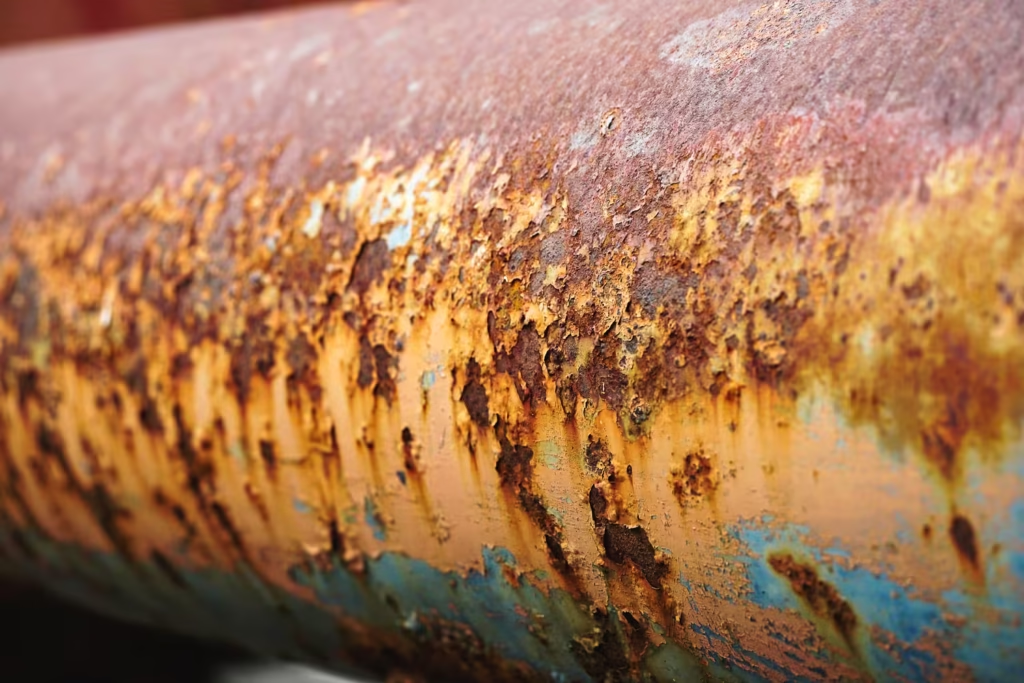
Corrosion costs the industry billions of zlotys annually, with bridges requiring premature renovation, machinery out of service, and steel structures deteriorating within a few years being its most severe consequences. In most of these cases, the problem lies not in the quality of the steel, but in the lack or poor selection of surface protection. The two solutions that most often come up in discussions about metal protection are hot-dip galvanizing and nickel plating. Although both protect against corrosion and have a well-established position in the industry, they operate differently, cost differently, and are suitable for completely different situations.
Hot-dip galvanizing – what is it and how does it work?
The process begins with surface preparation through degreasing, acid pickling, and fluxing, which removes oxides and prepares the metal for plating. When the component is placed in a bath of molten zinc at approximately 450°C, the zinc penetrates the steel surface and forms a series of zinc-iron alloys, upon which a top layer of pure zinc is deposited. The coating does not lie on the steel, but is metallurgically bonded to it., which makes it difficult to tear off or peel off.
The protection mechanism works on two levels: the zinc coating isolates the steel from the environment, and even if damaged, the zinc corrodes instead of the steel near the scratch, electrochemically protecting the substrate. This property ensures that minor scratches incurred during installation do not compromise protection, which is crucial in construction environments. The coating thickness is typically 50–150 µm, and the process can be repeated on worn components to extend the life of the structure without the need for replacement.
Nickel plating – process, characteristics and applications
Nickel plating is a galvanic process in which nickel is deposited on a metal surface using an electric current in an electrolytic bath. The element, acting as a cathode, attracts nickel ions, uniformly covering the entire surface. Before entering the bath, the element undergoes mechanical polishing, degreasing, and chemical activation, as the quality of the final coating depends on the quality of these steps. Nickel plating can be performed in multiple layers, combining soft and hard nickel to achieve very different mechanical properties.
Nickel gives a mirror-like, silvery shine Abrasion-resistant and retaining its appearance for years, aesthetics are often the primary reason for choosing this technology for premium products. Besides its appearance, nickel offers good corrosion resistance, high hardness, and resistance to many chemicals, which is why it is used on steel, copper, and brass, often as a base for chrome plating. In electronics, nickel plating protects contacts from oxidation, in jewelry, it provides a lasting aesthetic effect, and in precision components, it allows for micrometer-precision dimensional control.
Direct comparison: hot-dip galvanizing vs. nickel plating
Hot-dip galvanizing is a fast and simple process, allowing it to be completed in a matter of hours, even for large batches. Nickel plating requires more precise preparation and process control, making it slower and more labor-intensive. The cost of galvanizing is significantly lower, especially for large components, while nickel plating is more expensive due to the cost of nickel and the complexity of the process.
The zinc coating is 50–150 µm, while nickel is typically 5–50 µm, although its tightness and hardness are greater. Zinc has a matte, grayish appearance, while nickel has a shiny, elegant finish. In terms of durability, outdoor hot-dip galvanizing can last 20–50 years without maintenance, while nickel plating in such environments performs less well, although in chemically aggressive environments or where abrasion resistance is important, it performs better. Re-galvanizing is simple and inexpensive, while re-nickel plating requires careful removal of the old coating, making it more expensive and labor-intensive. Because zinc is fully recyclable, hot-dip galvanizing is also more environmentally friendly, whereas traditional nickel plating baths contain regulated substances that require careful waste management.
Advantages of hot-dip galvanizing – why is it a popular solution?
Hot-dip galvanizing is a solution for projects of all scales, as securing a multi-ton structure is cost-effective even on a tight budget, and the entire process can be completed in one business day. The durability of the coating reaches 50 years in outdoor conditions, allowing for precise lifecycle planning, while power poles, bridges, and railings galvanized decades ago remain intact. Electrochemical zinc protection prevents minor scratches from creating corrosion initiation points, a feature other barrier coatings fail to address. Because galvanized components require no maintenance for decades, the overall cost of maintaining a structure is significantly lower than with other protection methods.
Advantages of nickel plating – aesthetics and precision
Mirror shine The nickel-plated surface is durable and abrasion-resistant, giving bathroom fixtures, decorative elements, and premium hardware their appearance. Precise control of the coating thickness allows for the exact coating required without affecting the dimensions of the finished component, which is crucial in precision engineering, where tolerances are measured in micrometers. Multi-layer nickel plating, combining soft and hard nickel, produces coatings with optimized properties, as the soft inner layer provides adhesion, while the hard outer layer protects against abrasion. The ability to nickel-plate various base materials, from steel to copper to brass, provides significant technological flexibility for projects with varying requirements.
Practical applications in various industries
In construction and infrastructure, hot-dip galvanizing is unrivaled, as bridges, power poles, hall structures, and balustrades operate in variable conditions for decades, and zinc provides protection without any intervention. In the automotive industry, both technologies have their place, albeit in different areas. Chassis and suspension components benefit from galvanizing for their resistance to salt and moisture, while decorative interior components are nickel-plated for their aesthetics and abrasion resistance.
In electronics and precision engineering, nickel plating is standard to prevent oxidation of contacts and connectors throughout the life of the device. The maritime and port industries, on the other hand, are the domain of hot-dip galvanizing, as components exposed to seawater and salt require a thick, durable coating that will last for years. In household appliances, a combination of both approaches is often used, where steel structures are galvanized and visible decorative elements are nickel- or chrome-plated. In jewelry, nickel plating as a base for gold or silver plating is a standard production step to ensure the durability and aesthetics of the final product.
How to choose between hot-dip galvanizing and nickel plating?
Budget is the first factor, as hot-dip galvanizing is cheaper and cost-effective for projects of all sizes, while nickel plating makes sense when its properties are truly needed. The working environment is a key factor in many cases, as outdoor components exposed to rain, salt, and fluctuating temperatures are the natural environment for galvanizing, while chemically aggressive conditions and the high abrasion resistance required are areas where nickel plating yields better results.
Aesthetics often dictate the final decision more than technical parameters. When a component is visible and intended to convey a sense of quality, galvanizing with its matte finish isn't sufficient. And if the component is hidden or purely technical, paying for the shine of nickel is unjustified. The base material also matters, as galvanizing is exclusively applied to steel, while nickel plating can be applied to steel, copper, brass, and other metals. It's also worth remembering that galvanizing can be easily and inexpensively repeated, while re-nickel plating is more expensive and labor-intensive. Therefore, galvanizing is more beneficial in the long run for components that are regularly serviced.
At Strumet, we've been galvanizing steel for years, and we know that choosing the right coating is half the success of any project. If you're wondering which solution is best for your project, contact us. We'll be happy to help you make the right decision.
FAQ – frequently asked questions about hot-dip galvanizing and nickel plating
- Can hot-dip galvanizing and nickel plating be combined? In one design, yes, although it does not make technological sense on the same element, and when different components have different requirements, it is necessary to ensure the insulation of the contacts to avoid galvanic corrosion.
- How long do both coatings last? Hot-dip galvanizing lasts 20–50 years outdoors without maintenance, while nickel plating lasts less under these conditions, although it performs better in controlled and chemically aggressive environments.
- Is nickel plating more ecological than zinc plating? No, because zinc is fully recyclable and nickel baths contain regulated substances that require careful waste management.
- How do the two coatings look different? Zinc plating produces a matte, greyish surface with a characteristic crystalline structure, while nickel plating produces a silvery, mirror-like shine, making the difference immediately visible.
- Can both coatings be removed? Yes, although zinc is removed simply and cheaply as a standard step before re-galvanising, whereas nickel requires a more precise chemical process, making it more expensive to refinish.
- What materials can be zinc and nickel plated? Hot-dip galvanizing applies only to steel and cast iron, while nickel plating can be used on steel, copper, brass, bronze and aluminum, provided the surface is properly prepared.