We regard steel galvanizing as one of the most reliable methods of corrosion protection, especially where structures operate in varied and demanding environmental conditions. In our work we rely on metallurgical and electrochemical phenomena, because this combination makes it possible to create a coating that not only isolates the steel from its surroundings but also actively protects it through sacrificial protection. Such a coating remains stable for many years, and we can precisely control its properties at every stage of the process. From experience we know that galvanizing technology plays an important role in construction, power generation, transport and industry, because it determines whether a structure keeps its parameters for a few seasons or for decades.
What Steel Galvanizing Involves and Why a Zinc Coating Protects So Effectively Against Corrosion
When working with zinc coatings, we always rely on the difference in electrochemical potential between zinc and iron. Zinc acts as a galvanic anode, while steel behaves like a cathode, which means that zinc takes over the corrosion process. This arrangement guarantees protection even when the coating is locally damaged, because the galvanic cathodic protection mechanism remains active. It is precisely this property that makes steel galvanizing one of the most effective protective technologies.
During service we observe how the surface of the zinc coating gradually becomes covered with a layer of zinc oxides, hydroxides and basic carbonates. This patina forms a stable, tightly adhering protective layer that further limits the access of oxygen and moisture to the metal. Such a layer significantly slows the rate at which the coating is consumed, especially in moderate environments, where the patina develops evenly and remains durable for a long time.
Hot-Dip Galvanizing - The Process, Coating Properties and the Importance of Fe-Zn Metallurgy
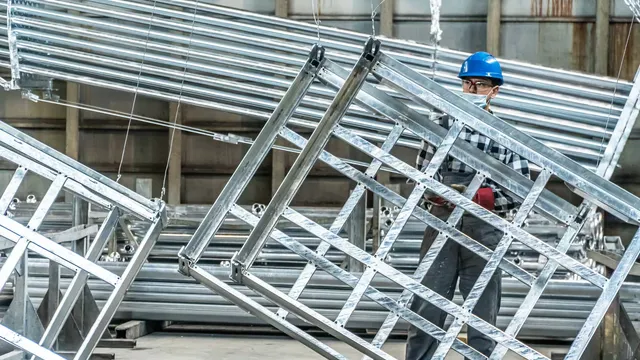
Hot-dip galvanizing involves immersing steel components in liquid zinc at a temperature of about 450°C. Under these conditions zinc reacts with steel and forms metallurgical Fe-Zn alloy layers. The coating structure consists of gamma, delta, zeta and eta layers, each of which is responsible for a different material property. The deepest layers are characterized by high hardness and mechanical resistance, while the outer layer of pure zinc provides electrochemical protection.
The zinc coating formed in the hot-dip process is an integral part of the component, not just an applied layer. Its durability depends on the bath temperature, the immersion time and the chemical composition of the steel, especially the silicon and phosphorus content. It is a proper analysis of the steel grade that makes it possible to predict the growth rate of the Fe-Zn layers and avoid the undesirable Sandelin effect (a phenomenon in which steel with a certain silicon content reacts too intensively and forms a thick, matte and more brittle coating). A well-run hot-dip galvanizing process delivers a coating with excellent resistance to weather and mechanical stress, which makes this method indispensable for large steel structures.
Zinc Electroplating - A Precise Zinc Coating Produced by the Electrolytic Method
We carry out zinc electroplating in an electrolyte solution in which the part acts as the cathode, and zinc is deposited on its surface under stable, controlled conditions. The process takes place at room temperature, which allows us to control the thickness and structure of the coating precisely and to match it to the requirements of high-precision components.
In practice, the most important factor is the current density, which shapes the size of the zinc crystallites and affects the uniformity of the surface. Alkaline baths work well for components with complex geometry, while acid baths produce a fine-grained, aesthetically pleasing coating with increased resistance to white corrosion. The final stage is passivation, which stabilizes the freshly deposited zinc and increases the service resistance of the coating. In our work we use chromium-free passivation based on titanium and zirconium compounds, because it ensures the durability of the layer while being safe for the environment.
Why Steel Galvanizing Delivers Such Long Durability in Practical Applications
A zinc coating is consumed evenly and predictably. Under standard conditions, its degradation rate is typically 1-2 μm per year, so a coating a few dozen micrometers thick can last for several decades without additional intervention.The predictability of the consumption process is one of the reasons why steel galvanizing is considered the most cost-effective technology in corrosion protection. In a duplex system, that is, a combination of galvanizing and painting, durability increases even more, because the paint limits oxygen access, and the steel remains protected by the zinc layer even in the event of micro-damage to the paint coating.
When assessing the durability of protection, we always refer to the corrosivity categories in accordance with the PN-EN ISO 12944 standard. In C1-C2 environments, typical of dry or slightly humid interiors, the zinc coating is consumed very slowly and can provide protection for several decades. In categories C3-C4, characteristic of urban and industrial areas, the stable degradation rate allows many years of protection with an appropriate coating thickness. In C5 / CX environments, where structures are exposed to salt spray, high humidity or aggressive industrial gases, galvanizing still works as effective protection, but it requires a greater coating thickness or the use of a duplex system, which can extend the service life of the structure by several times.
Technical Facts About Galvanizing
- Fe-Zn layers in hot-dip galvanizing reach a hardness of up to 300 HV, so the coating effectively protects steel not only against corrosion but also against mechanical damage, which standard paint coatings are unable to counteract.
- In electroplating processes we react to every change in current density, because even a slight deviation can change the structure of the deposit and its resistance to white corrosion. For this reason we continuously monitor bath parameters and carry out regular laboratory analyses.
- Zinc exhibits a capacity for local ion migration, which helps limit the development of corrosion at micro-damage sites. We see this property especially in situations where a paint coating stops protecting the steel immediately after its continuity is broken.
- In environments with elevated CO₂ content, the zinc patina forms faster and is more uniform, which improves the long-term stability of the coating. In urbanized areas we clearly see that this phenomenon reduces the rate at which the layer is consumed.
- During hot-dip galvanizing we control how the component is cooled, because the rate of heat release affects the formation of microcracks in the outer layers of the coating. Correct temperature control translates directly into the durability and flexibility of the Fe-Zn layer.
- In electroplating we observe the phenomenon of current shadowing, in which current reaches edges more intensely than recesses. That is why, when setting parameters, we make sure the deposit forms evenly across the entire part and does not cause differences in coating thickness.
Galvanizing at Strumet
At Strumet we treat steel galvanizing as an important element of the entire structure protection technology. We take care of surface preparation, stable bath parameters and proper process conditions, because they determine the quality and durability of the zinc coating. We analyze the steel composition and select the immersion time and method so that the coating forms evenly and retains its properties over time.
A process run in this way allows us to obtain coatings that are resistant, uniform and predictable in service. If you need galvanizing carried out under controlled conditions and with full responsibility for the result, we will prepare the components so that they meet the requirements.