Choosing a Gitterbox comes down to four decisions: load capacity, internal dimensions, wall construction and interchangeability status in the EPAL pool. Each of them has a measurable effect on the cost of circulation. A container that does not match the part generates empty space in the trailer, a mesh opening that is too large forces the use of dividers, and a carrier from outside the pool means your own container management and settling balances with counterparties. Below we have prepared a summary of the standardized parameters and the criteria used to match the design to a specific process.
What is a Gitterbox? Definition, construction and standards
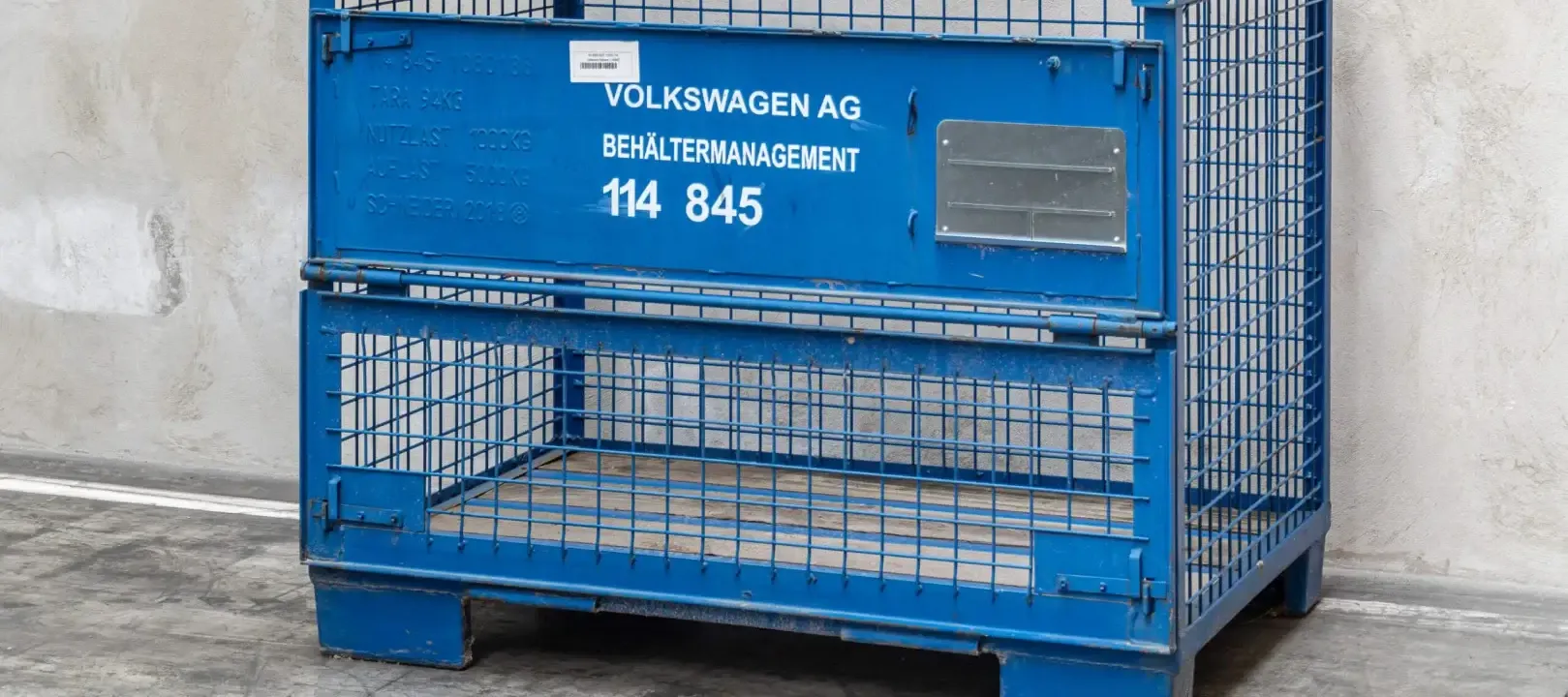
Gitterbox is a metal mesh container (box pallet) built from a steel frame, welded mesh walls and two hinged flaps in the front wall, intended for the transport and storage of bulk goods and general cargo. The name comes from German (Gitter – grid, mesh) and has become established throughout European logistics as the term for a standardized pallet cage.
The construction is simple and therefore reliable. A mesh with openings typically 50 × 50 mm, made of wire approx. 4 mm in diameter, is stretched over a rigid steel angle frame. The floor in the pool version is made of four wooden boards, and in industrial versions it can be a steel sheet. The whole stands on four legs or runners, thanks to which the container can be stacked and lifted with forks from four sides. With proper use and routine repairs, such a carrier works for many years and repays its purchase cost many times over.
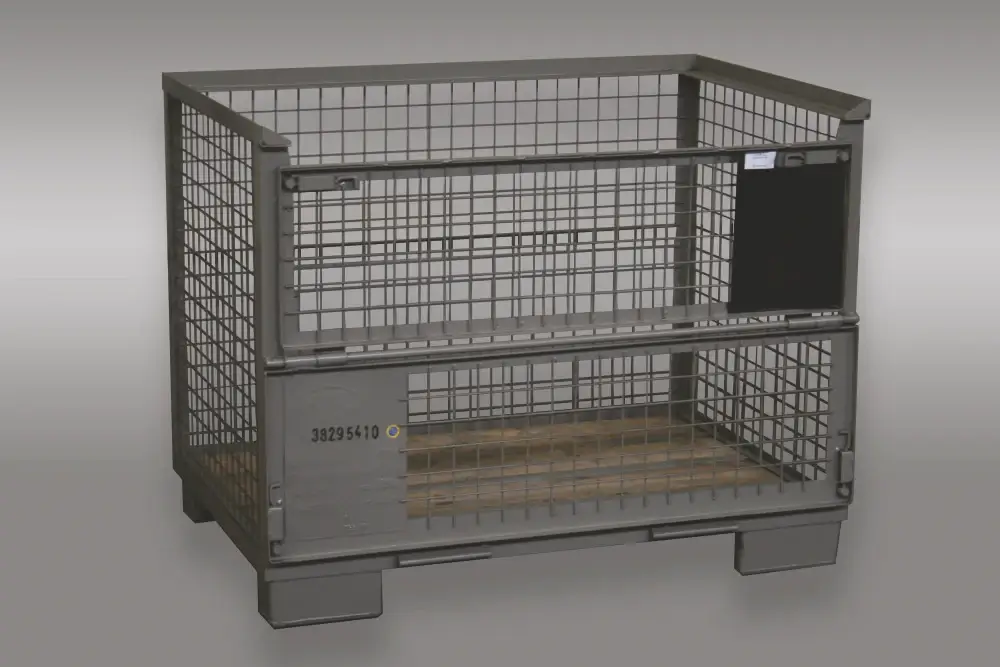
The origin of the standard goes back to the German standard DIN 15155:1986, which defined a box pallet with mesh walls and two front-wall flaps. The standard has been formally withdrawn, and the dimensional standard and exchange rules are now maintained by the EPAL system, which took over the role of the earlier UIC railway guidelines.
You can recognize a unit approved for exchange by its markings: the EPAL mark in an oval, an embossed letter "Y" with a number and a control seal.
Types of Gitterboxes – design and functional variants
We differentiate Gitterboxes by three criteria: construction, dimensions and equipment. Construction determines rigidity and how much space an empty carrier takes up in return transport, while equipment determines what load the container can actually hold.
| Type | Construction | Typical application |
| Standard pool | Fixed, welded, 50 × 50 mm mesh | Universal circulation, general cargo, components |
| Collapsible | Fold-down walls on hinges | Space savings in return transport |
| With lid | Mesh and a closable roof | Protection of contents, stacking |
| Sheet-lined | Sheet metal instead of mesh | Bulk materials, chips, small parts |
| With textile insert | Mesh and soft lining | Painted components sensitive to abrasion |
| For airbags | Dedicated, reinforced construction | Pyrotechnic modules subject to ADR regulations |
A conventional EPAL box pallet works wherever interchangeability with logistics partners matters. If, however, a part does not fit the standard geometry or the rack clearance forces a different height, the alternative is a custom-size Gitterbox – in a separate article we described which parameters can be changed and what the ordering process looks like.

Gitterbox dimensions – the EPAL standard and usage parameters
In practice you will encounter two dimensional references, and it is worth telling them apart. The EPAL specification gives internal dimensions of 1200 × 800 mm and a height of 970 mm, while the external size, counted including the frame and flaps, is approx. 1240 × 835 mm, and it is this that determines the space taken up in the trailer and on the rack.
| Parameter | Reference value |
| Length and width (internal dimension per EPAL) | 1200 × 800 mm |
| External size (value adopted by the market) | Approx. 1240 × 835 mm |
| Height | 970 mm |
| Load volume | 0.75 m³ |
| Load capacity | 1500 kg (units manufactured before 1990: 900 kg) |
| Tare weight | 70 kg (units manufactured before 2011: approx. 85 kg) |
| Stacking | Max. 6000 kg of pressure on the lowest container, on a hard and level surface |
These values describe a pool container and, for most processes, are a sufficient point of reference. When a process requires a different height, a higher load capacity or a non-standard base, the carrier is designed individually, while maintaining compliance with the rules for stacking and fork lifting.
Applications of Gitterboxes in industrial logistics
The versatility of the Gitterbox means it appears in almost every branch of industry. In the automotive sector it serves as returnable packaging circulating between the supplier and the assembly plant, while in production plants and warehouses it serves as a transport container for parts, scrap, process waste and bulk materials. It also works well in inter-plant transport and export, where interchangeability in the European EPAL pool is key.
Automotive – returnable packaging and component transport
The automotive industry imposes the strictest requirements. Carriers must circulate in a closed loop, meet the quality requirements of Tier 1 and OEM suppliers and guarantee repeatable dimensions so that they fit robotized workstations. The Gitterbox often works here together with dedicated pallets for automotive parts, forming a complete, returnable packaging system for the entire supply chain: from the press shop to the final assembly line.
Production, warehouses and industrial cooperation
Outside automotive, Gitterboxes handle the basic material flow in almost every production hall. They carry parts between machining operations, collect chips and scrap at machine tools and buffer semi-finished products ahead of the next workstation. The same logic works in industrial cooperation, where parts travel between plants at different stages of processing. In that case a durable, stackable carrier determines the smooth flow of the whole process.

Gitterbox versus other containers and metal pallets – how to choose a carrier?
A Gitterbox is not always the optimal choice. The choice is determined by the nature of the load, the need for ventilation or visibility of the contents and the stacking requirements. For bulk materials a solid sheet will work better, and for profiles and tubes – specialized metal pallets for long goods.
| Criterion | Gitterbox | Sheet-lined container | Pallet for long goods |
| Type of load | General cargo, components | Bulk materials, chips, small parts | Profiles, tubes, long items |
| Visibility and ventilation | High (mesh) | None (sheet metal) | Depends on the construction |
| Stacking | Very good | Very good | Limited by the dimensions of the load |
How to choose a Gitterbox matched to your production
Start selecting a carrier with hard parameters. Determine the maximum weight and size of the load, measure the space of the line, racks and means of transport, and estimate the circulation frequency and operating conditions, including humidity, contact with chemicals and pressure washing. In short, it comes down to four questions:
- What weight and what dimensions of the load, and therefore what required load capacity?
- Should the carrier be interchangeable in the EPAL pool, or dedicated to a closed loop?
- Open mesh, lid, sheet metal or a protective insert?
- How many circulation cycles per year and in what environment?
In automotive, quality requirements and repeatability of dimensions confirmed by production control at the supplier are added to this list.
Strumet produces standard and custom-size Gitterboxes, integrating them with full corrosion protection from its own hot-dip galvanizing plant. Contact us if you want to select the right carrier and receive a quote.
FAQ – the most common questions about Gitterbox mesh boxes
What are the load capacity and volume of a standard Gitterbox?
A standard Gitterbox has a load capacity of 1500 kg and a load volume of 0.75 m³, with internal dimensions of 1200 × 800 mm and a height of 970 mm. When stacking on a hard, level surface, the load on the lowest container should not exceed 6000 kg.
How does a Gitterbox differ from an ordinary metal pallet?
A Gitterbox is a box pallet enclosed on the sides, with mesh walls, so it holds loose loads and general cargo that a flat pallet does not secure. A classic metal pallet serves mainly as a base for packaged or large-size goods.
Is it better to buy Gitterboxes outright or use exchange in the EPAL system?
In the so-called EPAL pool, carriers remain the property of the users and circulate among them on a one-for-one exchange basis, which simplifies settlements with partners but limits the choice to the pool format. Dedicated containers pay off with a closed loop, non-standard parts and high quality requirements, because they give full control over condition and availability.
Which Gitterboxes work well for transporting automotive parts?
It is best to invest in dedicated containers with repeatable dimensions and increased durability, optionally with inserts protecting painted components. Loads covered by ADR regulations, such as airbag modules, require a reinforced version with a special construction, and the supplier itself should meet the quality requirements placed on Tier 1 and OEM partners.