Steel corrosion consumes several percent of the GDP of industrialized countries annually. Fortunately, it can be effectively counteracted—and real savings can be achieved. One of the most effective and cost-effective methods for protecting steel elements from rusting is galvanic zinc plating. That's why, in the machinery, automotive, energy, construction, and telecommunications industries, a proven galvanizing facility is an invaluable business partner. Let's take a closer look at what this term means, and what standards a modern galvanizing facility should meet.
What is an electroplating plant and what is it used for?
In short, electroplating plant Strumet Galvanizing specializes in electrolytic zinc plating, a process in which a thin layer of zinc is deposited on a metal surface using direct current and electrolytic baths.
The zinc coating serves two functions here. First and foremost, it provides anti-corrosion barrier. Zinc protects steel both mechanically, isolating it from the environment, and electrochemically – as a metal with a lower electrochemical potential than iron, it oxidizes instead of the protected substrate. Due to these properties, metal galvanization It is one of the fundamental means of protecting the structure from exposure to moisture, aggressive chemicals, or changing weather conditions. A second aspect is aesthetics. Zinc coatings, available in a variety of finishes, give the structure a uniform appearance.
The galvanizing process step by step
Galvanic zinc plating This is a multi-stage technological process, the quality of which depends equally on the electrolysis parameters and the care with which the surface was previously prepared. Each stage directly impacts the coating's adhesion, uniformity, and protective properties.
Surface preparation: degreasing and etching
During the preparatory stage, the steel elements pass through several successive baths. Degreasing removes organic contaminants from metal: oils, greases, anti-spatter agents used in welding, and other surface-active substances that would prevent the even deposition of zinc. The next step is acid digestion, which removes iron oxides, mill scale, and rust, revealing a clean, metallically active substrate. The pickling time depends on the surface condition of the load; all components are also rinsed multiple times before the galvanic bath.
Electrolysis and zinc coating
The actual galvanization stage involves immersing the prepared elements in electrolytic bath containing zinc salts and passed through a direct current circuit. The mechanism is simple: zinc ions (Zn²⁺) migrate under the influence of an electric field towards the cathode (i.e., the galvanized element) and are reduced to metallic zinc, which deposits on the surface. The rate of coating growth, its texture, and mechanical properties depend on:
- current density (A/dm²),
- temperature and composition of the bath,
- pH value,
- presence and concentration of organic additives (brighteners, levelers, etc.).
These parameters are not constant, so in order to guarantee process repeatability, must be constantly monitored by computer systems and corrected by technologists.
Passivation and types of finishes
Freshly galvanized components – although already protected by zinc – require additional chemical treatment called passivation. This involves immersing the structure in chromate or chromate-free solutions, which create a thin, dense layer of oxides and hydroxides on the zinc surface. Depending on the composition of the passivation bath and the contact time, the following finishing options are possible:
- blue passivation (colorless) – the thinnest passivation layer with a slightly rainbow sheen;
- yellow (gold) passivation – thicker chromate layer, distinct golden yellow color, increased corrosion resistance;
- black passivation – a layer with the addition of silver or nickel salts in a bath, an aesthetic effect similar to oxidation.
At Strumet we use chrome-free passivation, based on titanium compounds, among other things. This treatment significantly extends the coating's resistance to white corrosion (zinc corrosion) and improves its barrier properties. Moreover, it is the most ecological method available.
Hanger and drum line at Strumet – a modern galvanizing plant in Silesia
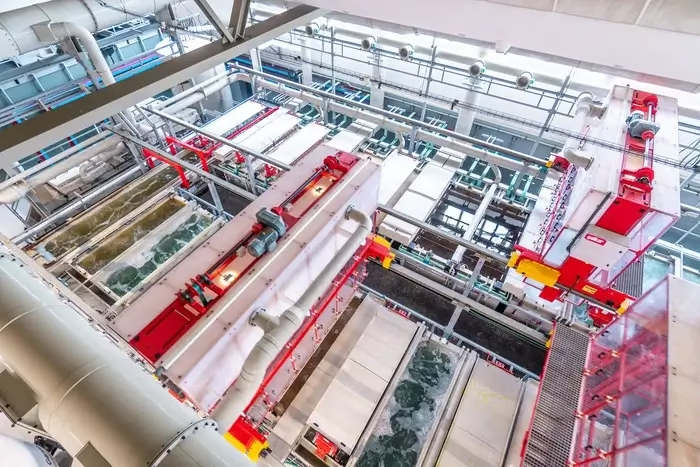
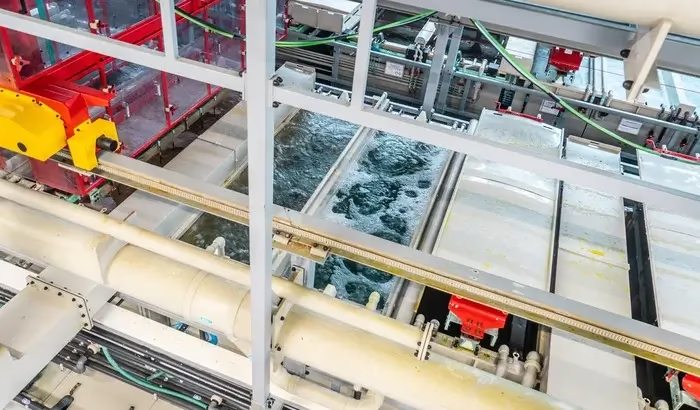
Strumet boasts over 30 years of experience in the industry, and we launched it in mid-2020 electroplating plant in Silesia is one of the most modern galvanizing installations in Poland. At the heart of the plant are two fully automated production lines. Suspension line is designed to handle larger structural elements. It can accommodate structures up to 2.8 m long x 0.8 m wide x 1.8 m deep, with a maximum load weight of 600 kg per beam and a surface area of up to 1200 dm² per beam. Drum line used for galvanizing small parts (connectors, screws, nuts, washers, clamps) in bulk.
Both lines are equipped with autonomous transporters, which transfer elements between subsequent process tanks without operator intervention. Bath parameters – temperature, pH, conductivity, zinc salt concentration, and organic additives – are recorded and monitored by a real-time computer monitoring system. Chemists with their own equipment ensure the correct composition of the technological solutions. analytical laboratory.
Why is it worth commissioning galvanizing? Quality, deadlines, and ecology
Different types of galvanization They are used in various industries; the specific solution is always selected based on the scale and desired effect. When it comes to electrogalvanizing, one of its greatest advantages is the ability to precisely control the thickness of the applied coating. Depending on the customer's requirements and the operating conditions of the structure, the plant offers coatings in a range of 3–25 µm (with fully repeatable results!). Furthermore, Strumet's modern infrastructure and processing capacity translate into competitive turnaround times – up to 24 hours for orders up to 100 kg, and a maximum of 72 hours for orders weighing 1-3 tons. Our galvanizing plant's daily throughput reaches 20,000 kg, making it one of the largest and most efficient in the country.
Finally, it's worth mentioning that Strumet's operations are always guided by care for nature. Thanks to the use of an advanced purification and regeneration system for technological solutions, the process baths operate in closed system (The installation does not produce industrial wastewater.) This solution complies with BAT standards and meets the strict environmental requirements for modern electroplating plants in the European Union.
FAQ – most frequently asked questions about electroplating
What is the difference between electroplating and hot-dip galvanizing?
Hot-Dip Galvanizing (HDG) involves immersing steel components in liquid zinc at a temperature of approximately 450°C. The resulting coating is very durable, but thicker and more locally differentiated, especially in corners and hard-to-reach areas. Electrolytic galvanizing is performed at ambient temperature using direct current. It allows for significantly thinner and more uniform coatings (3–25 µm), making it a recommended solution for threaded components, precision machined parts, and other components requiring precise dimensional tolerances.
What thickness of zinc coating can be obtained by electrolytic method?
The standard galvanizing process produces coatings in the 3–25 µm range. The most common thicknesses used in industry are 5–12 µm for components used indoors and 12–25 µm for components exposed to atmospheric conditions or aggressive media. Coating thickness is a controlled parameter and confirmed by measurements after the process is completed.
What are the minimum and maximum dimensions of components for electroplating?
The Strumet hanger line handles components with dimensions no larger than 2.8 m × 0.8 m × 1.8 m (length × width × depth), with a load weight of up to 600 kg per beam. If two dimensions are close to the limit, prior technical consultation is required. The drum line is designed for small, bulk components – the required minimum load is 20 kg per drum, with no specific maximum size limit for a single component (beyond the obvious drum volume limitations).
How long does it take to complete an order at the Strumet electroplating plant?
Orders up to 100 kg are completed within 24 hours, those from 100 kg to 1 ton within 48 hours, and those from 1 to 3 tons within 72 hours. For orders over 3 tons, the deadline is negotiated individually. This is one of the shortest lead times available on the Polish electroplating market.