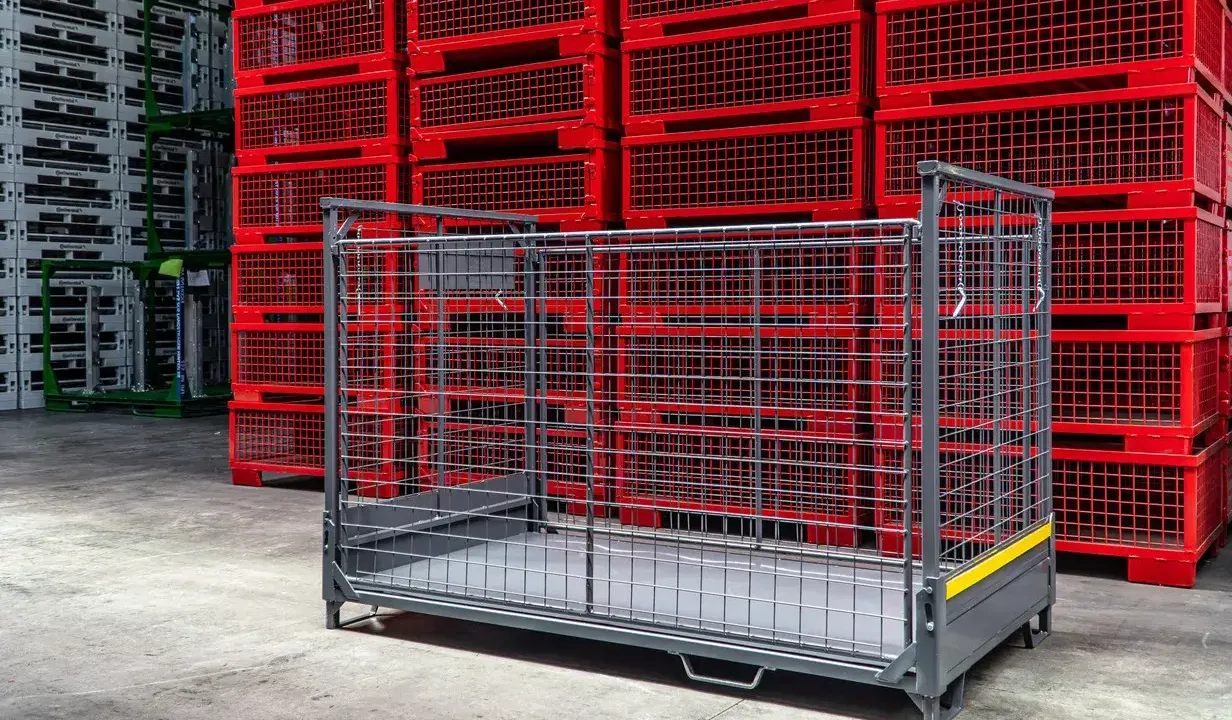
You know the Gitterbox from the production hall, the warehouse or technical documentation. You know it is sturdy, stackable and fits every forklift in Europe. And yet it happens that, for a specific component, machine or rack layout, a standard box simply does not work the way it should. In this article we explain when departing from the standard is justified from an engineering and economic point of view, which parameters can actually be modified, and what cooperation with the manufacturer looks like when ordering a custom-size box.
What is a Gitterbox and why has it become the standard in industrial logistics?
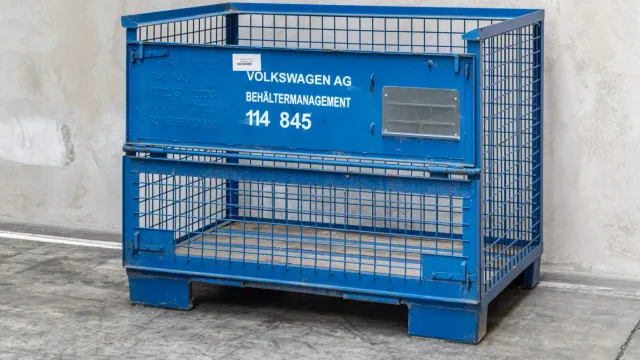
A Gitterbox is a steel transport and storage container with a frame of bars and welded mesh infill. Its history goes back to the mid-twentieth century, when European railways were looking for a unified way to transport goods. The result was the UIC 435-3 and DIN 15155 standards, defining the dimensions, load capacity and construction requirements of the so-called UIC mesh pallet – and it was precisely this standardization that determined the global success of the format.
The popularity of the Gitterbox comes from several practical advantages:
- Interchangeability – containers from different manufacturers fit the same forklifts, racks and transport systems.
- Stackability – stacking improves the use of storage area and cargo space.
- Durability – the steel construction withstands many years of use in demanding conditions.
- Visibility of contents – the mesh openings make it possible to identify goods without opening the container.
Standardization is a huge advantage – until the specifics of the product or process begin to limit it.

When are standard Gitterbox dimensions no longer enough?
The standard box works perfectly in thousands of typical applications. There are, however, situations in which its parameters become a problem.
- Specific component dimensions
Manufacturers of large-size components – stamped sheet metal, bumpers, aluminum profiles – often find that a standard Gitterbox is too low or too narrow. Components protrude beyond the edge, which risks damage and makes stacking difficult. Conversely, small parts fall through mesh openings that are too large or require dividers that generate additional costs. - Production line requirements
In automated plants, containers must fit perfectly into the slots of conveyors or loading robots. A difference of a few centimeters can mean having to rebuild the line – or ordering a container tailored to the existing infrastructure. - Space optimization
High-bay racks have strictly defined clearances. A container 100–150 mm lower can make it possible to add another storage level in the same hall without expanding the building.
Gitterbox dimensions – what can be changed and to what extent?
An experienced manufacturer of mesh boxes does not limit itself to the catalog. Practically every design parameter can be adjusted:
| Parameter | Range of modification |
| Base area | Any – smaller or larger than the standard 1200×800 mm |
| Height | Reduced (e.g., 600 mm) or increased (over 1000 mm) |
| Load capacity | Adjusted through the choice of profiles and mesh density |
| Mesh opening size | From 15 mm upward (standard 50×50 mm) |
| Floor and walls | Mesh or lined with sheet metal (for small and bulk components) |
| Finish | Powder coating, hot-dip or electrolytic galvanizing |
Reducing the mesh opening to 15–25 mm makes the container suitable for transporting bolts, gaskets or small castings without additional inserts. Lining the floor or walls with sheet metal eliminates the problem of goods falling out and makes it possible to store bulk or wet materials.
Collapsible or rigid Gitterbox mesh box – which to choose?
A rigid Gitterbox is simpler in design and cheaper to produce. It works wherever containers circulate in a closed loop – for example, between production halls and the warehouse or between the factory and a regular customer.
A collapsible Gitterbox can reduce the volume of an empty container by as much as 70–80%. A single semi-trailer will fit several times more collapsed boxes than rigid ones – an argument that cannot be overestimated for deliveries to many recipients or long-distance return logistics. The higher production cost usually pays back after just a few transport cycles.

Applications of Gitterbox containers in various industries
Wide configuration possibilities mean that Gitterbox mesh boxes have found use in very different environments:
- Automotive – containers transport stampings, castings and bumpers between suppliers and OEM factories. A reduced height or inserts protecting painted surfaces are often required.
- Agriculture – a Gitterbox with mesh walls ensures air circulation, which slows the spoilage of fruit and vegetables. Hot-dip galvanized versions work well in field conditions and with pressure washing.
- Retail and distribution – logistics centers use the boxes for order picking and for buffering goods. Dimensions matched to the racks can significantly increase warehouse throughput.
- Heavy industry – foundries and forges need containers with increased load capacity – versions with thicker wire and a steel floor work well here.
- Hospitality and laundry services – laundries serving hotels transport linen in Gitterboxes with a sheet-lined floor. The collapsible version is popular here because of return logistics.
What does the process of designing a made-to-order Gitterbox look like?
Ordering a custom-size Gitterbox does not have to be complicated. An experienced manufacturer guides the customer through the successive stages.
- Requirements analysis
The starting point is a conversation about what is to be transported, in what environment (temperature, humidity, contact with chemicals), what the space constraints are and whether the container will work with existing systems (racks, conveyors, forklifts). - Selection of the design
The designer selects the frame profile, the wire diameter and the mesh opening size. Load capacity must take into account not only the static weight of the load, but also dynamic loads during loading and stacking. - Choice of finish
This is one of the more important choices affecting durability and cost:
- Powder coating – economical, available in any RAL color, ideal for dry environments that are not chemically aggressive.
- Electrolytic galvanizing – a thin zinc coating giving corrosion resistance in standard conditions.
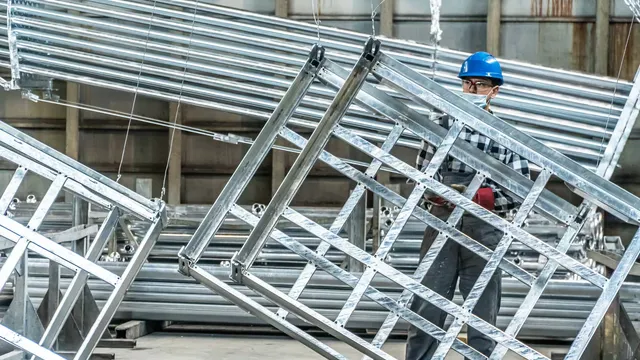
- Hot-dip galvanizing – a thick zinc coating (from 50 µm upward) providing long-term resistance in aggressive environments: outside buildings, with water washing, in contact with fertilizers.
- Prototype and validation. For larger series, the manufacturer makes a prototype for verification in real conditions before starting serial production.
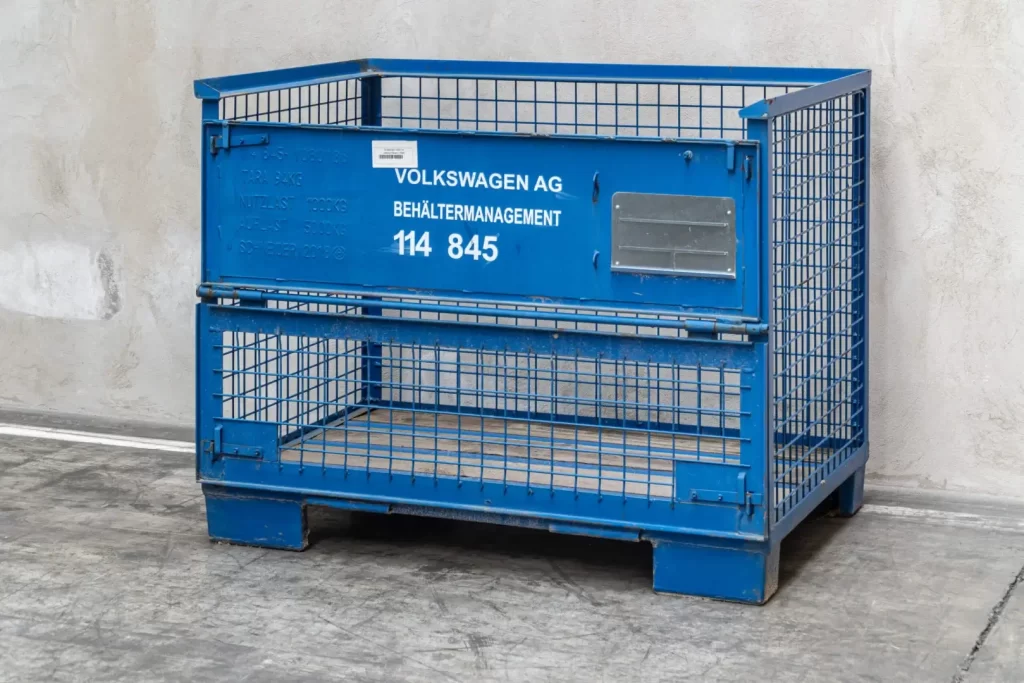
Strumet has produced transport and storage containers for more than 30 years – the Gitterbox was, in fact, the first product in its offering. This experience translates into concrete engineering knowledge: how to select a profile so that the container is durable and as light as possible, and how to design the hinges of the collapsible version for thousands of cycles. In addition, Strumet offers painting and galvanizing in one place, which shortens lead times and simplifies the logistics of the whole order.
FAQ – the most common questions about custom-size Gitterbox mesh boxes
What Gitterbox dimensions are available, and can they be configured completely freely?
A standard Gitterbox container has internal dimensions of 1200×800 mm and a height of approx. 970 mm, but the manufacturer can make it in any dimensions. The base area, height, mesh opening size and the type of floor and walls can all be changed – with no predefined limits.
How does a hot-dip galvanized Gitterbox differ from a powder-coated one?
Hot-dip galvanizing provides a much thicker and more durable corrosion protection coating – irreplaceable in outdoor environments, with water washing or contact with aggressive substances. Powder coating is cheaper and offers wide color options, but works mainly in dry conditions inside buildings.
Is a custom-size Gitterbox more expensive than a standard one, and what does the price depend on?
The unit cost of a custom-size Gitterbox can be higher than that of a catalog container, because it does not benefit from the economies of scale of series production. The price is affected by the complexity of the design, the chosen finish, the size of the series and any prototype costs. For larger orders the difference compared to the standard is often minimal, while the gain from a better fit is significant.
How long does it take to fulfill an order for non-standard mesh boxes?
The lead time depends on how non-standard the design is, the chosen finish and the manufacturer's current workload. Usually the whole process – from requirements analysis through the prototype to delivery of the series – takes from several to a dozen or so weeks. The exact date is set individually after analyzing the order.