Corrosion remains one of the most costly problems facing modern industry. Component replacements and structural repairs result in unplanned downtime, critical infrastructure failures, and safety threats that cannot be quantified individually.
However, metal corrosion is not a random or inevitable phenomenon. It can be predicted, controlled and effectively limited. The prerequisite is to understand its mechanisms: when chemical corrosion occurs and when electrochemical corrosion occurs, why corrosion pitting is more dangerous than uniform oxidation, and what determines whether one protective coating will last 30 years while another will fail after two seasons.
What is corrosion and why does it destroy metal from the inside?
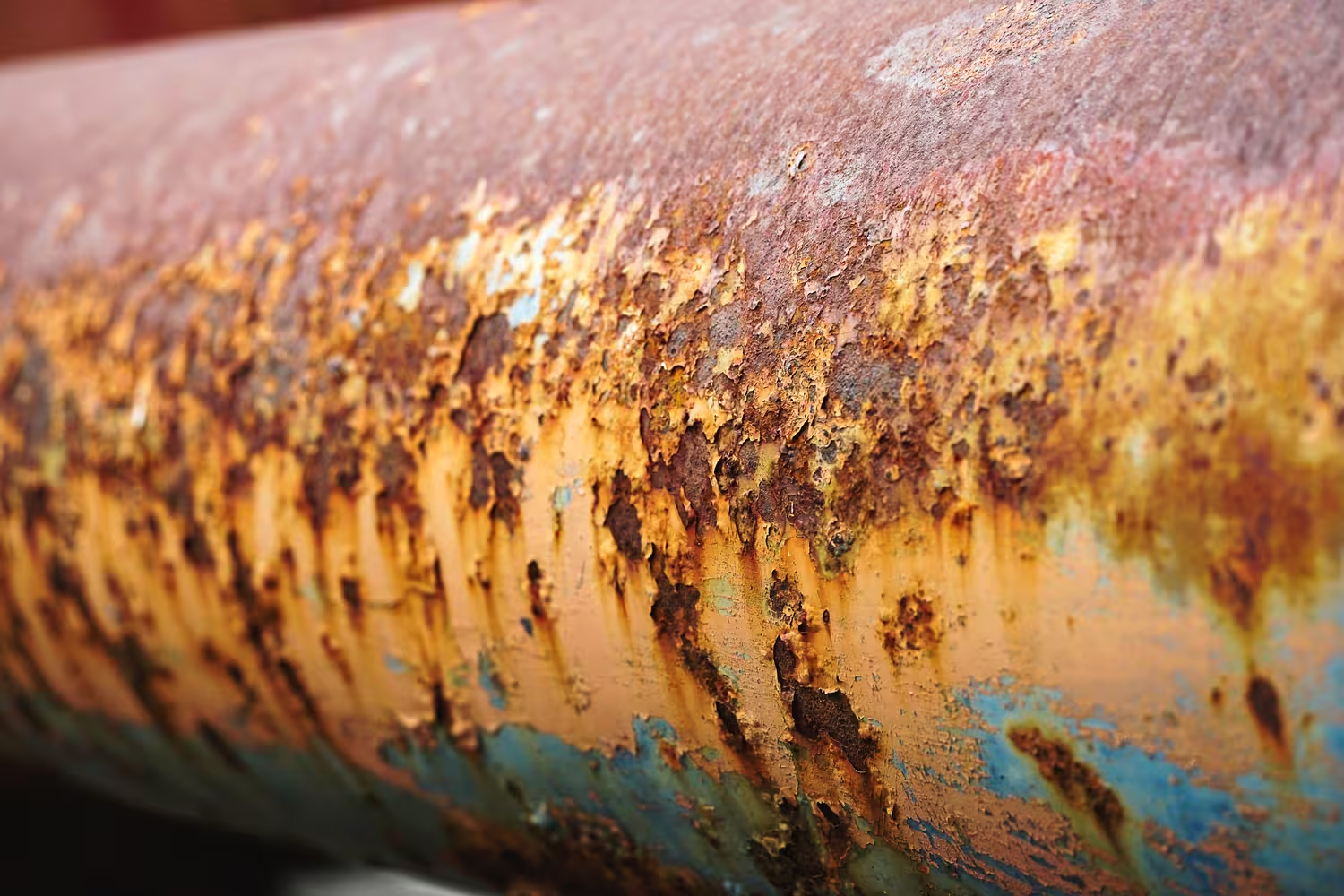
Metal corrosion is a spontaneous, irreversible degradation process of a metallic material that occurs under the influence of environmental influences, either chemical or electrochemical. In both cases, it leads to destruction of the material structure and loss of its functional properties.
It's crucial to understand that corrosion isn't just an aesthetic problem. A rusting structure isn't pretty, but before the changes become visible to the naked eye, the metal loses its mechanical strength, ductility, and fatigue resistance. Cracks initiated by corrosion pitting can lead to the sudden failure of a component that still appears functional from the outside.
The susceptibility of a metal to corrosion depends on the chemical composition of the alloy, the type and aggressiveness of the environment, temperature, internal stresses and the presence of protective layers.
Chemical and electrochemical corrosion – how do they differ and when do they occur?
Although both types of corrosion lead to metal degradation, they differ in their mechanism, environment, and speed. Distinguishing between them has practical implications, determining the appropriate protection method.
Chemical Corrosion – a Reaction Without Electricity
Chemical corrosion occurs in dry or non-electrolytic environments when a metal reacts directly with an aggressive medium without the use of an electrical current. Typical examples include high-temperature oxidation, sulfidation Whether contact with concentrated acids.
In industry, chemical corrosion primarily affects:
- engine and turbine components – exposed to hot exhaust gases containing SO₂ and NOₓ,
- industrial furnaces and heat exchangers – operating in an oxidizing or reducing atmosphere at high temperatures,
- chemical installations – in contact with concentrated acids or bases.
If the products of this reaction form a tight, adherent layer, they can act as a protective layer (as in the case of aluminum or chromium). If they are porous and brittle, they accelerate further degradation.
Electrochemical corrosion – the most common enemy of steel
Electrochemical corrosion is responsible for the vast majority of damage to steel structures, pipelines, and infrastructure. It occurs in electrically conductive environments (electrolytes)—rainwater, damp soil, seawater, and even condensed water vapor.
The mechanism is based on the creation local galvanic cells:
- Anode – a more active area of the metal where oxidation occurs and the metal dissolves.
- Cathode – a less active area where the reduction of oxygen or hydrogen ions occurs.
- Electrolyte – ion-conducting medium (e.g. rainwater, soil, seawater).
- Metallic connection – ensuring the flow of electrons between the anode and the cathode.
The local anode and cathode can be formed by two different metals (e.g., steel and copper), but also by micro-regions within a single alloy—grain boundaries, precipitate phases, and stress zones. Therefore, electrochemical corrosion attacks even seemingly homogeneous steel components.

➤ We also recommend reading the article Rusting of galvanized sheet metal: causes, prevention and solutions
The types of metal corrosion that we most often encounter in industry
In industrial practice, the morphology of damage is more important than the mechanism itself – that is, how corrosion attacks the material and where it is most difficult to detect.
| Type of corrosion | Characteristic | Easy to detect |
| Even | Uniform loss over the entire surface | Easy |
| Pitting | Deep, local defects with minor general changes | Difficult |
| Crevice | Intensive degradation in closed places (crevices, overlaps) | Very difficult |
| Galvanic | Accelerated corrosion of a more active metal when in contact with a more noble one | Mean |
Uniform corrosion is paradoxically the mildest form – it allows for a predictable assessment of the element's service life. Pitting corrosion poses a serious threat to stainless steel and aluminum in chloride environments. Pitting is small in cross-section but significant in depth and can penetrate the pipe or tank wall before being detected. Crevice corrosion This applies to joints, overlaps, and all hard-to-reach areas. It's particularly insidious – it's initiated by the difference in oxygen concentration between the interior of the crevice and the open area, leading to acidification of the electrolyte and a rapid acceleration of the process. Galvanic corrosion, often underestimated at the design stage, occurs wherever metals with different potentials come into contact, e.g. steel screws in aluminum structures.
Steel corrosion in practice – what losses does the industry suffer?
According to NACE International IMPACT study The global cost of corrosion reaches $2.5 trillion annually, which is equivalent to approximately 3.41 TP³ of global GDP. More important than the global statistics, however, are the losses in specific industries:
- Automotive – corrosion of bodies, chassis and suspensions shortens the life of vehicles; manufacturers now require documented anti-corrosion protection methods from their suppliers.
- Rail transport – corrosion of wagon chassis and track elements generates repair and downtime costs; railway infrastructure is exposed to winter salt, water and variable temperatures.
- Agriculture – working machines operate in environments with high humidity and contact with mineral fertilizers, which act as an aggressive electrolyte.
The common denominator of these challenges is the need to effectively protect metal components at the production stage.
Corrosion prevention – what does effective metal protection depend on?
Effective corrosion protection always requires a combination of proper material selection, thoughtful design, and appropriate surface protection technology. The main methods include:
- Metallic coatings – zinc plating, nickel plating, chrome plating. They create a durable physical barrier or provide cathodic protection (zinc protects the steel even after the coating is damaged).
- Organic coatings – paints, varnishes, powder coatings. Effective as additional protection, but require proper surface preparation.
- Cathodic protection – used for underground and underwater structures; changes the polarity of the metal, eliminating anodic areas.
- Corrosion inhibitors – chemical additives to the electrolyte (e.g. cooling systems, water installations).
- Material selection – avoiding galvanic couples, using stainless steels in aggressive environments.
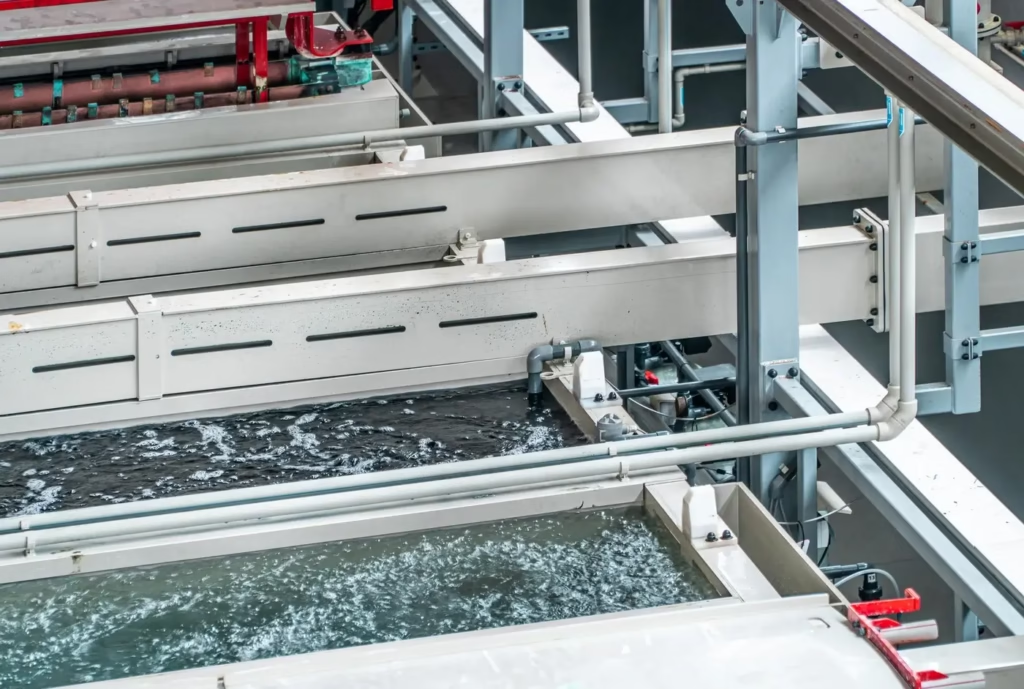
Of the above methods galvanizing remains one of the most widely used and reliable technologies for protecting steel. Zinc protects it in two ways: as a physical barrier, blocking access to oxygen and electrolyte, and as a protector – an anode that corrodes instead of the steel when the coating is mechanically damaged.
Hot-dip galvanizing works especially well with large, heavy steel structures exposed to weather conditions – the coating thickness of 50–100 µm ensures durability for several decades. Plating allows for precise control of coating thickness and properties, making it an optimal solution for smaller components requiring precise dimensional tolerances.
Finally, it is worth noting that both hot-dip galvanizing and galvanizing steel not only provides protection against corrosion, but also improves the surface appearance and its abrasion resistance.

FAQ – most frequently asked questions about metal corrosion
What is the difference between chemical and electrochemical corrosion?
Chemical corrosion occurs in dry environments without the use of an electrolyte – the metal reacts directly with the aggressive agent without the flow of current. Electrochemical corrosion requires an electrolyte and proceeds by creating local galvanic cells; it is responsible for the vast majority of corrosion damage in construction and industry.
Which metals are most susceptible to corrosion?
Iron and carbon steel are among the most susceptible to electrochemical corrosion in the presence of moisture. Aluminum (passivating Al₂O₃ layer), titanium, and chromium-containing stainless steels exhibit high inherent resistance.
Is steel corrosion always visible to the naked eye?
No – pitting and crevice corrosion can reach significant depths with the outer surface remaining virtually unchanged. In industrial practice, they require diagnostic methods: ultrasonic testing, radiography, or dye penetrant testing.
What corrosion prevention methods are most effective?
The effectiveness of the method depends on the operating environment and durability requirements. In industry, zinc coatings (hot-dip galvanic for large structures, electroplating for precision components) work best, supplemented with paint coatings. The most important thing is to adapt the method to the specific operating conditions.