Hot-dip galvanizing is one of the most effective methods of protecting steel from corrosion. With proper preparation, a zinc coating can protect a structure for 30, even 100 years without any maintenance. The problem is that many defects that only become apparent in the galvanizing plant originate much earlier – at the design or welding stage. We've compiled five common mistakes that most often complicate the galvanizing process and reduce the coating's durability.
1. Selecting the right steel grade – the foundation for durable hot-dip galvanizing
The chemical composition of the steel directly affects how the reaction with liquid zinc proceeds. The silicon (Si) and phosphorus (P) content are particularly important. Hot-dip galvanizing gives the best results for steel with silicon content below 0.03% or in the range of 0.15–0.25% (This is due to the so-called Sandelin effect.) Steels with Si contents in the range 0.03–0.14% can overreact: the coating becomes too thick, brittle, and grayish instead of shiny. A similar effect is caused by increased phosphorus content.
The mistake is that designers select steel solely based on strength parameters, ignoring its reactivity in the zinc bath. The solution is to verify material certifications before commissioning the galvanizing operation and, if possible, select steel described as "suitable for hot-dip galvanizing.".
2. Technological holes – guarantee of safety and quality of the coating
This is the most serious technical error, which can have serious safety consequences. Closed profiles (pipes, crates, boxes) without venting or drainage, immersed in liquid zinc at a temperature of approximately 450°C, can rupture violently due to the expansion of trapped air or liquid vapor. The lack of proper drainage also adversely affects quality, as zinc accumulates inside the profiles, creating lumps, "icicles," and areas of uneven coating thickness.
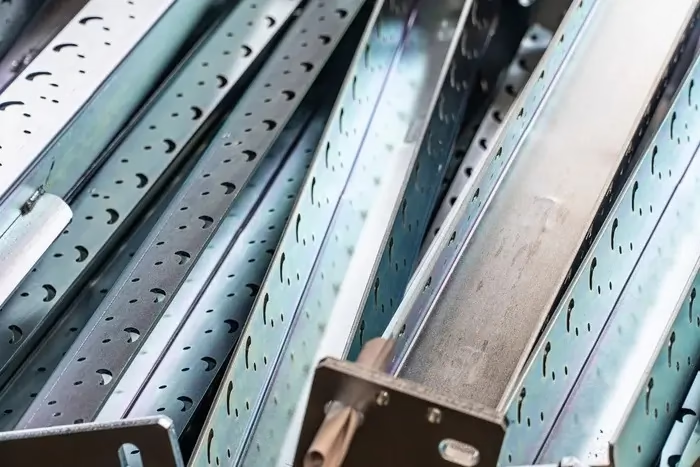
Correctly designed holes should be located at the lowest and highest points of each closed cross-section to eliminate the need for rotating the part during the process. The minimum size of the holes depends on the dimensions of the profile – detailed guidelines in force in hot-dip galvanizing plant The structure is presented in the table below:
| Internal dimensions of the closed profile (mm), less than: | Minimum diameter of holes (mm) at opposite ends of the profile and their number: | ||||
| Round | Square | Rectangular | 1 hole | 2 holes | 3 holes |
| 15 | 15 | 20 × 10 | 8 | – | – |
| 20 | 20 | 30 × 15 | 10 | – | – |
| 30 | 30 | 40 × 20 | 12 | 10 | – |
| 60 | 60 | 80 × 40 | 20 | 12 | 10 |
| 80 | 80 | 80 × 60 | 20 | 18 | 12 |
| 100 | 100 | 120 × 80 | 25 | 20 | 12 |
| 120 | 120 | 160 × 80 | 30 | 25 | 16 |
| 160 | 160 | 200 × 120 | 40 | 25 | 16 |
| 200 | 200 | 260 × 140 | 50 | 30 | 16 |
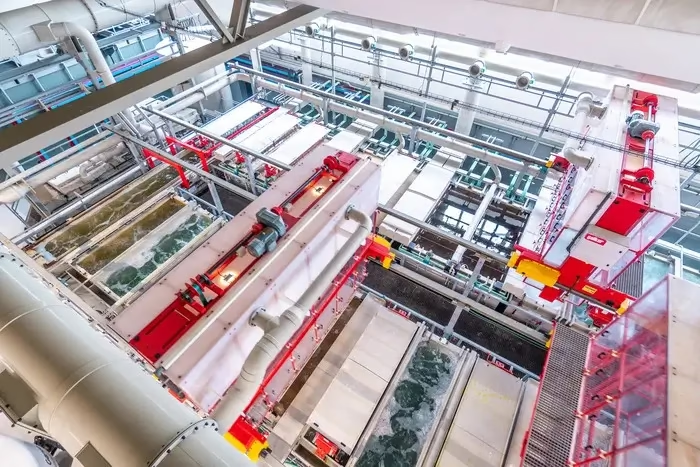
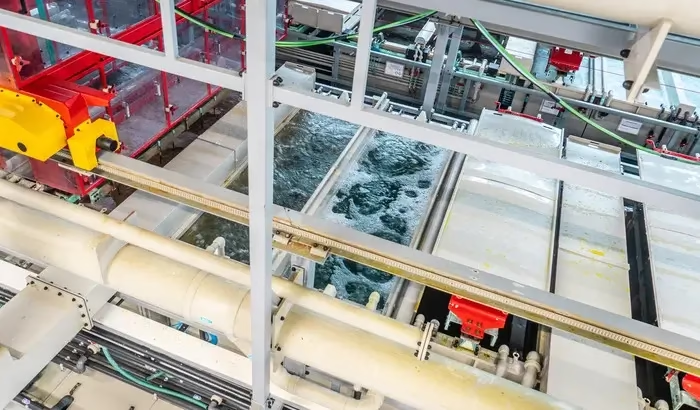
Our galvanizing plant has a tank measuring 10.2 x 1.4 x 2.7 m, which allows for galvanizing large and complex structures – but this is precisely why their run-off design requires special care.
3. Hot-dip galvanizing and electroplating – why do they require a different approach?
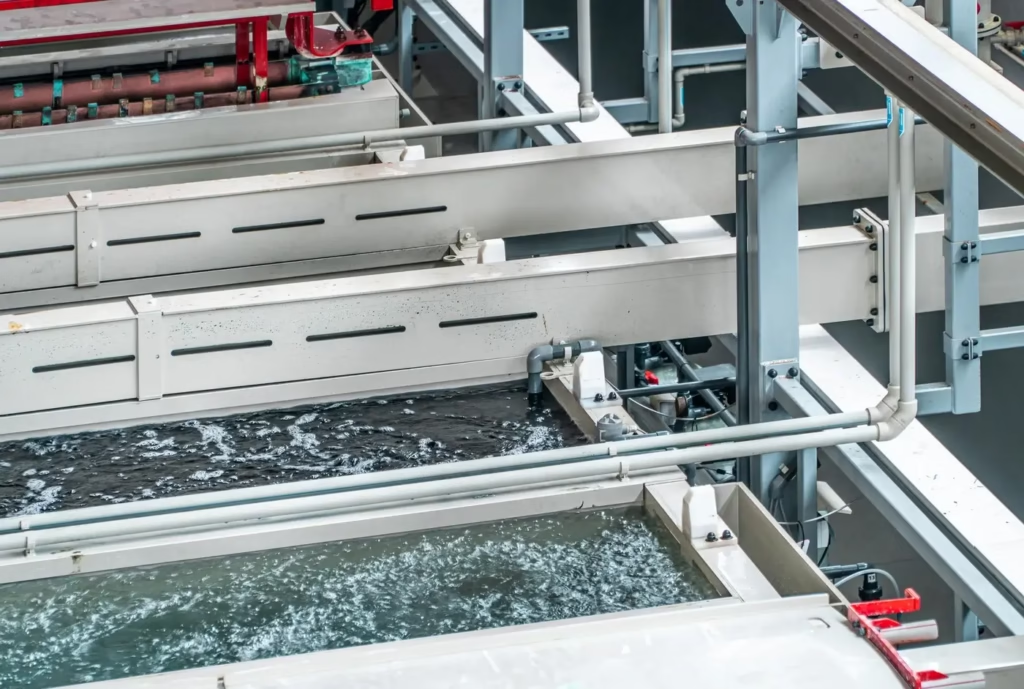
The difference between hot-dip galvanizing and electroplating It's not just the coating thickness (50–100 μm vs. 3–25 μm), but above all, the different requirements for the detail geometry. In hot-dip galvanizing, the components are immersed in a bath of liquid zinc, so gaps and lap joints become a trap for the acids used in the pickling process. If the sheets are overlapped without continuous welding or without maintaining a gap of at least 2.5 mm in the case of intermittent welds, the acid becomes trapped between the sheets. After galvanizing, it gradually leaches out, causing subcoal corrosion and characteristic rust-colored "leaks.".
As indicated Polish Galvanizing Society, the principle is simple: either a continuous and tight weld or an interrupted one with an appropriate clearance. .Never overlap without welding at all.
4. Welds and joints – how to weld so that the galvanized steel does not rust at the contact points?
A zinc coating is only as good as the substrate it rests on. Weld slag, spatter, unpolished pores, and excessively rough weld faces prevent even zinc application. In these areas, the zinc coating is thinner, non-uniform, or even non-adherent—presenting entry points for corrosion.
In accordance with industry guidelines (e.g. as described in:. Engineer's Guide) welds for hot-dip galvanizing should be made using the semi-automatic method in a gas shield. Welding with coated electrodes carries the risk of poor coating quality, as the welding coating must be removed before galvanizing – and in practice, this can be difficult with complex structures. The edges of the components must be chamfered or rounded: a sharp edge causes the zinc to flow and does not achieve the required protective thickness.
Technological process hot-dip galvanizing in Strumet takes into account the inspection of the substrate before immersion, however, the responsibility for the quality of the welds always lies with the construction contractor.
5. Duplex system, or how to prepare the surface for painting galvanized steel
If a customer plans to paint after galvanizing (a so-called duplex system), they should be aware that fresh hot-dip galvanized steel is a difficult substrate for paint. The smooth, passive zinc oxide surface bonds poorly to paint coatings, especially alkyd and epoxy coatings. A solution is to perform a light abrasive sweep abrasive. sweep blasting) or use of a primer specifically designed for zinc.
A properly selected paint applied to galvanized steel using the duplex system not only allows for the production of any RAL color, but also – thanks to the synergy between the two coatings – significantly extends the time to first maintenance compared to galvanizing or paint alone. The durability of the duplex system is estimated to be from 1.5 to 2.5 times longer than the sum of the durability of each layer separately.
FAQ – most frequently asked questions about preparing steel for galvanization
Does galvanizing rust after a few years of use?
The zinc coating itself does not rust – zinc is a metal that corrodes much slower than steel and forms stable carbonate compounds (patina) on its surface, which further slow down the degradation process. If rust appears on a galvanized structure, it most often occurs at mechanical damage sites, on sharp edges, at faulty welds, or – as described above – as a result of subsurface corrosion resulting from design errors.
What types of galvanizing are there and which one to choose for large structures?
The basic types of galvanizing are hot-dip galvanizing and galvanic zinc plating (electrolytic). For large steel structures exposed to harsh weather conditions, we strongly recommend hot-dip galvanizing – it provides a coating that is several times thicker and more durable.
Is the galvanizing process at Strumet environmentally safe?
Yes. The Strumet hot-dip galvanizing plant operates on a wastewater-free system. The chemical baths used in the process are closed in an internal circuit – no liquid process waste is discharged into the environment.
How quickly can Strumet galvanize my job?
The turnaround time depends on the size and complexity of the order. For example, for a batch weighing up to 3 tons, completion is possible within 10 hours. It's best to contact our sales department directly.
If you have any doubts about the preparation of your structure, do not wait until the problem becomes apparent at the galvanizing plant. Contact us already at the design stage – we will help you avoid costly rework and provide a coating that will protect your steel for decades.