Every steel structure operates in a different environment - a railing in a heated office corrodes differently from a gantry next to a coastal industrial hall. Choosing the right protection therefore starts with one question: how aggressive is the environment in which the steel is expected to last several decades? The answer is organized by corrosivity categories - a standardized system that lets you move from a general "it's humid and salty here" to a concrete decision about the thickness of the zinc coating. Below we explain what these categories are, how to identify the right one, and how to match corrosion protection to it.
What Are Corrosivity Categories?
Corrosivity categories are a standardized way of describing how strongly a given environment attacks unprotected metal. The scale covers five basic levels - from C1 (practically non-aggressive environment) to C5 (very aggressive) - and since 2017 also a CX category for extreme conditions. The classification is defined by ISO standards, and the reference point is not a subjective assessment but the measurable mass or thickness loss of standard steel and zinc specimens after one year of exposure.
As a result, the "corrosivity category" has become part of the common language of investors, designers, and contractors. A single designation (e.g., C4) clearly defines how intensely corrosion will progress and how durable the protection must be - and this translates directly into the choice of technology and the expected service life of the structure.
ISO 12944 and ISO 9223 - the Basis of Classification
Corrosivity categories are not arbitrary but result from two related standards. ISO 9223 classifies the corrosivity of atmospheres on the basis of three factors: the time of wetness of the surface (humidity and temperature), sulfur dioxide (SO₂) pollution, and air salinity (chlorides). It is these parameters that decide whether a given location belongs to C2 or perhaps to C4.
In turn, ISO 12944-2 - the part of the standard devoted to corrosion protection of steel structures - carries this knowledge over into design practice. It defines atmospheric corrosivity categories based on the mass (or thickness) loss of standard specimens after the first year of exposure, and additionally describes typical environments assigned to each category.
In practice, the category is determined in two ways: precisely - by exposing reference specimens for a year and measuring their loss (in accordance with ISO 9226), or indicatively - by comparing the conditions at the investment site with the environment descriptions in the standard. When the results for steel and zinc point to different categories, the higher (more aggressive) one is adopted.
Corrosivity Categories C1-C5 - Characteristics
The table below collects all the categories together with example annual material loss - a good starting point for a preliminary assessment.
| Category | Corrosivity | Typical environment | Steel loss (µm/year) | Zinc loss (µm/year) |
| C1 | very low | heated interiors, clean air | ≤ 1.3 | ≤ 0.1 |
| C2 | low | unheated interiors, rural areas | > 1.3-25 | > 0.1-0.7 |
| C3 | medium | cities, moderate industry | > 25-50 | > 0.7-2.1 |
| C4 | high | industry, coastal zones | > 50-80 | > 2.1-4.2 |
| C5 | very high | heavy industry, marine zones | > 80-200 | > 4.2-8.4 |
C1 - Very Low Corrosivity (Heated Interiors, Offices)
Environments with a clean, dry atmosphere and practically no condensation: office buildings, schools, hotels, shopping centers. Steel corrodes here at a negligible rate and often needs no separate protection apart from aesthetic considerations.
C2 - Low Corrosivity (Unheated Interiors, Rural Areas)
Atmospheres with a low level of pollution and unheated interiors with periodic condensation - warehouses, sports halls, and outdoors, rural areas away from industry. Corrosion is slow, and zinc coatings reach a very long service life here.
C3 - Medium Corrosivity (Cities, Moderate Industry)
Corrosivity category C3 is one of the most common environments in Polish conditions. It covers urban and industrial atmospheres with a moderate concentration of SO₂ and coastal areas with low salinity. Typical facilities: structures in urban agglomerations, fences and shelters along roads, and also production rooms with elevated humidity (breweries, dairies, food processing plants).
C4 - High Corrosivity (Industry, Coastal Zones)
Corrosivity category C4 describes clearly aggressive environments: chemical plants, swimming pools, shipyards, and coastal areas with moderate salinity. The combined action of moisture and aggressive pollutants means that choosing protection already requires a conscious decision about coating thickness, and often about a complex system.
C5 - Very High Corrosivity (Heavy Industry, Marine Zones)
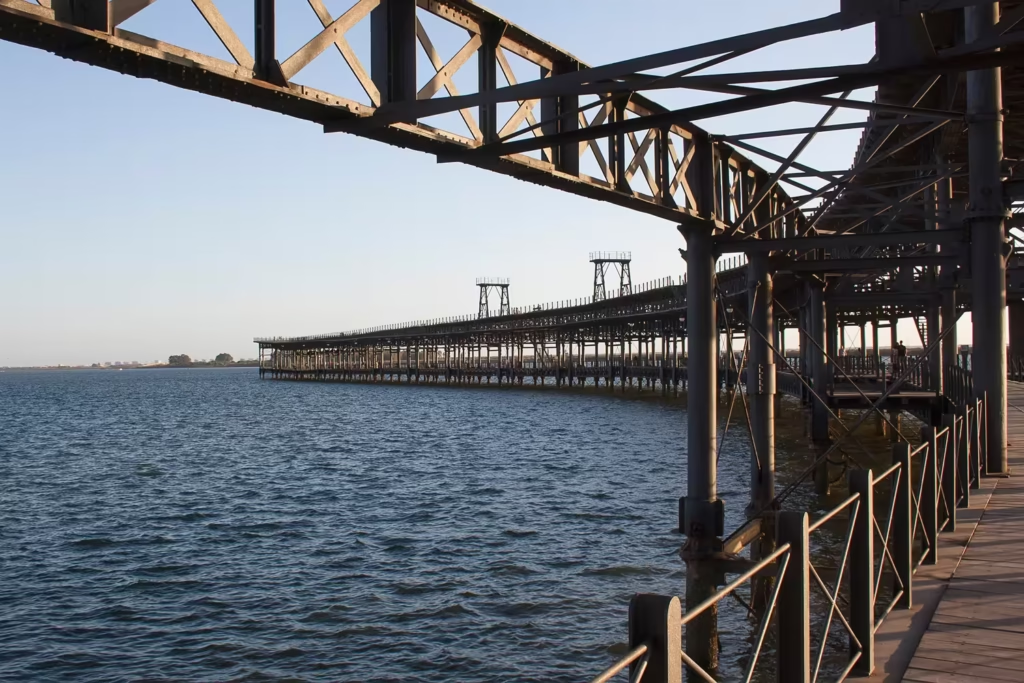
The most demanding of the basic categories: areas with almost constant condensation and high pollution, as well as coastal and marine zones with high salinity - heavy industry installations, quayside port structures, facilities in the immediate vicinity of the sea. Thin coatings wear out quickly here, and enhanced protection is often necessary.
Zinc Coating Thickness and Corrosivity Category
Here we come to the heart of design. The thickness of the zinc coating in hot-dip galvanizing is not arbitrary - it depends primarily on the thickness of the steel, and its minimum values are specified by the ISO 1461 standard.
| Thickness of the steel element | Local thickness (min.) | Mean thickness (min.) |
| < 1.5 mm | 35 µm | 45 µm |
| ≥ 1.5-3 mm | 45 µm | 55 µm |
| > 3-6 mm | 55 µm | 70 µm |
| > 6 mm | 70 µm | 85 µm |
The other half of the equation is the rate of zinc consumption in a given category - the higher the category, the harder the coating "works". Combining the thickness with the annual zinc loss gives us the estimated durability, that is, the time to first maintenance. The values below (for a typical coating of about 85 µm on steel thicker than 6 mm) are based on ISO 14713 data.
| Category | Annual zinc loss | Estimated durability of an 85 µm coating |
| C1 | ≤ 0.1 µm | over 100 years |
| C2 | 0.1-0.7 µm | approx. 100 years or more |
| C3 | 0.7-2.1 µm | approx. 40-100+ years |
| C4 | 2.1-4.2 µm | approx. 20-40 years |
| C5 | 4.2-8.4 µm | approx. 10-20 years |
In corrosivity category C3 conditions, a coating thickness of the standard 85 µm provides several decades of protection without intervention - hot-dip galvanizing performs without reservations here. In corrosivity category C4, the coating thickness must already be greater or the maintenance more frequent; the same 85 µm lasts for about 20-40 years.
How to Match Corrosion Protection to Your Corrosivity Category
A practical decision scheme for the designer and investor can be reduced to a few steps:
- Determine the corrosivity category - based on location, proximity to industry, distance from the sea, and humidity (ISO 9223 / ISO 12944-2).
- Define the required durability - that is, the expected time to first maintenance (e.g., 15, 25, or over 50 years).
- Check access for maintenance - structures that are hard to reach or cannot be replaced require a larger durability margin.
- Select the technology - zinc coating thickness or a complex system.
For categories C1-C3, hot-dip galvanizing alone provides very long protection and is usually fully sufficient. At C4 it still works well, especially when the structure is made of thicker galvanized steel or when reinforced coatings are used. In the toughest category, C5 - with constant moisture and high salinity - it is worth considering a duplex system, that is, hot-dip galvanizing with a paint coating. The two barriers work synergistically: the paint protects the zinc from rapid wear, and the zinc protects the steel cathodically even where the paint is damaged.
If you are facing a decision about protecting a steel structure and want to be sure the coating matches its service conditions - contact Strumet. We will help you choose a solution appropriate to the corrosivity category and the expected durability.
FAQ - Most Common Questions About Corrosivity Categories
What is the difference between corrosivity categories C1-C5?
They differ in the aggressiveness of the environment, measured by the annual loss of steel and zinc. C1 means practically non-aggressive conditions (heated interiors), and C5 means very aggressive environments (heavy industry, marine zones), in which metal corrodes many times faster.
How can I check which corrosivity category my environment belongs to?
Most accurately - by exposing reference specimens for a year and measuring their loss (ISO 9226). For an approximate assessment, it is enough to compare the conditions at the investment site (humidity, pollution, proximity to the sea and industry) with the environment descriptions in the ISO 12944-2 standard.
Which corrosivity category applies to coastal and industrial zones?
Most often C4 (moderate salinity, industry, coastal zones) or C5 (high salinity, heavy industry, immediate vicinity of the sea). Assignment to a specific category is determined primarily by the level of chlorides and pollutants in the air.
Is hot-dip galvanizing sufficient for category C5?
Yes, although in the toughest C5 conditions (constant moisture, very high salinity), the durability of the zinc coating alone may be limited. In such cases, thicker coatings or a duplex system (zinc + paint) are recommended, which significantly extends the time to first maintenance.