Transport packaging is a cost that recurs with every shipment. Cardboard, foil, and wooden crates are used up in a single delivery cycle, so the expense recurs with each subsequent shipment. Reusable metal containers work differently: a one-time investment is spread over over a hundred cycles, reducing the cost per delivery. In the automotive industry, closed-loop steel and galvanized structures have been standard for years, and the EU's PPWR regulation—with its goals of reusing transport packaging—is further accelerating the shift away from single-use packaging.
What are the features of reusable metal containers?
Reusable metal containers are steel or galvanized transport and storage structures designed for repeated use in the supply chain – unlike disposable cardboard boxes and wooden crates, which become waste after unloading. They are designed to returned to sender dozens, and often hundreds, of times, maintaining full functionality for many years.
The most commonly used types include: gitterbox (mesh basket), sheet metal container, airbag container, and metal pallet for car parts. Despite their design differences, they share the same features:
- standardization of dimensions enabling stable stacking,
- adapted to be operated with forklifts and loading robots
- long-term durability thanks to the use of steel and galvanizing.
The zinc coating protects the structure against corrosion in humid halls and during transport in changing weather conditions.
Disposable packaging vs. returnable container – TCO calculation
Comparing the purchase price alone leads astray – a disposable cardboard box will always be "cheaper" than a steel container. Only the conversion makes sense. total cost of ownership (TCO), which breaks down the cost by the number of actual cycles and takes into account hidden costs. The key factor is not the unit price, but rather how many times a given package is recycled and whether it can earn a living.
| Type of packaging | Number of cycles (rotation) | Nature of the cost | Cost per delivery (trend) |
| Cardboard + filling | 1 | Cost incurred in full on each shipment | The highest in the long term – growing with each subsequent delivery |
| Wooden box | 3–5 | The production is spread over several cycles, then it is discarded. | Medium – limited by short lifespan |
| Returnable metal container | 100+ | One-time investment outlay | The lowest – decreases with each subsequent rotation |
When it comes to disposable packaging, it's easy to overlook costs that don't appear on the invoice: waste disposal after each delivery, storing empty cartons, and order processing for each batch. These items can significantly increase the actual unit cost above the invoice value. In the return model, the investment is made once, and reusability reduces dependence on disposable materials and lowers the cost per rotation. This mechanism is confirmed by Reusable Packaging Europe analysis, according to which returnable packaging generates long-term operational savings throughout the life cycle. For companies in the automotive industry, well-designed returnable automotive packaging becomes an infrastructure element, not a recurring variable cost.
How to calculate the break-even point for a returnable container?
The moment when the investment pays off is most convenient to count in number of rotations, not in zlotys:
cost of purchasing the container ÷ cost of one disposable package = number of returns
The container is returned when the number of its cycles exceeds the quotient of the purchase cost and the cost of a single disposable packaging that it replaces with each delivery.
The translation of this number into time depends on circulation frequency – the faster a container returns to the sender, the sooner savings begin to accrue. With well-organized reverse logistics, a well-made container reaches the return threshold well before the end of its lifespan (100+ rotations), and all use after that point is pure savings. The actual calculation depends on the durability of the coating, rotation frequency, and reverse logistics costs.
Gitterbox, sheet metal container or basket with insert – which type to choose?
The choice of container type depends primarily on the nature of the part and the line requirements. Strumet offers three solutions covering most industrial applications:
- Gitterbox – a mesh basket that allows for visibility of contents and free air circulation; suitable for large and bulky items and parts that require ventilation (e.g. wet or oiled after machining), where a quick visual inspection of the condition is essential.
- Sheet metal container – solid walls protect the contents against dust and mechanical damage; a foldable version is available to save space during return transport, and the closed form works well for small details and loose materials that could fall through the mesh.
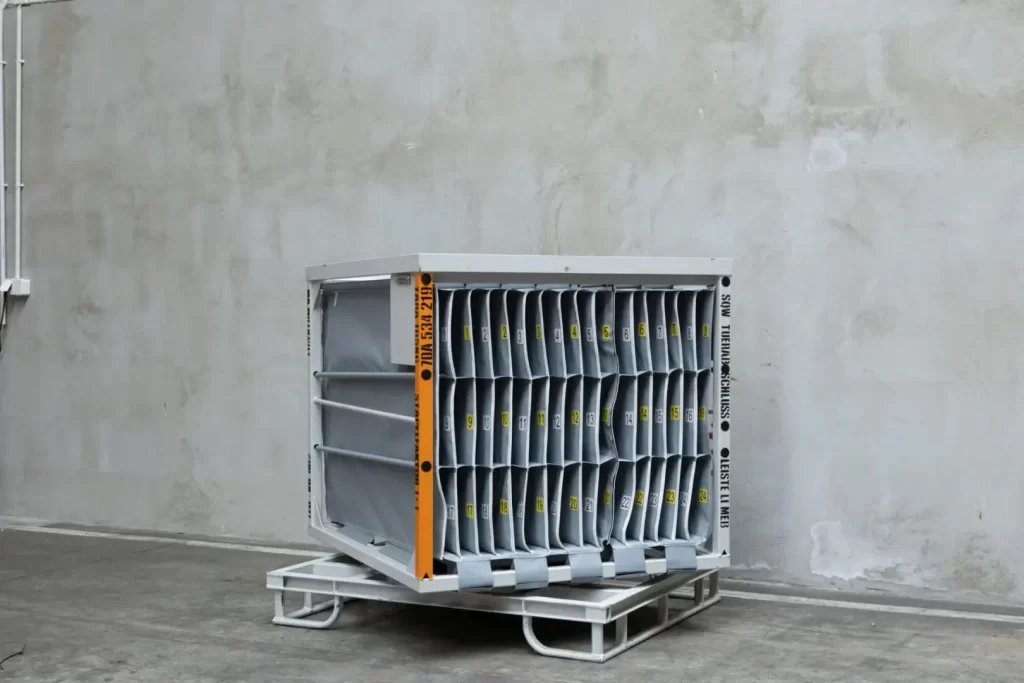
- Container with textile insert – soft lining protects delicate painted and finished parts from scratches.
Custom-made containers – when is a standard gitterbox not enough?
Standard dimensions work well for typical components, but some applications require a custom-made solution. A standard container is no longer sufficient when:
- non-standard dimensions of details, which do not fit into the type series,
- requirements of a robotic loading line, where repeatable positioning counts,
- specific shelving system recipient or operation by AGV trolley.
In such situations, Strumet designs and manufactures custom-made containers, e.g. custom-made gitterbox, with full engineering support – from technical drawing, through prototype, to series production.
Airbag containers – transport requirements and ADR certification
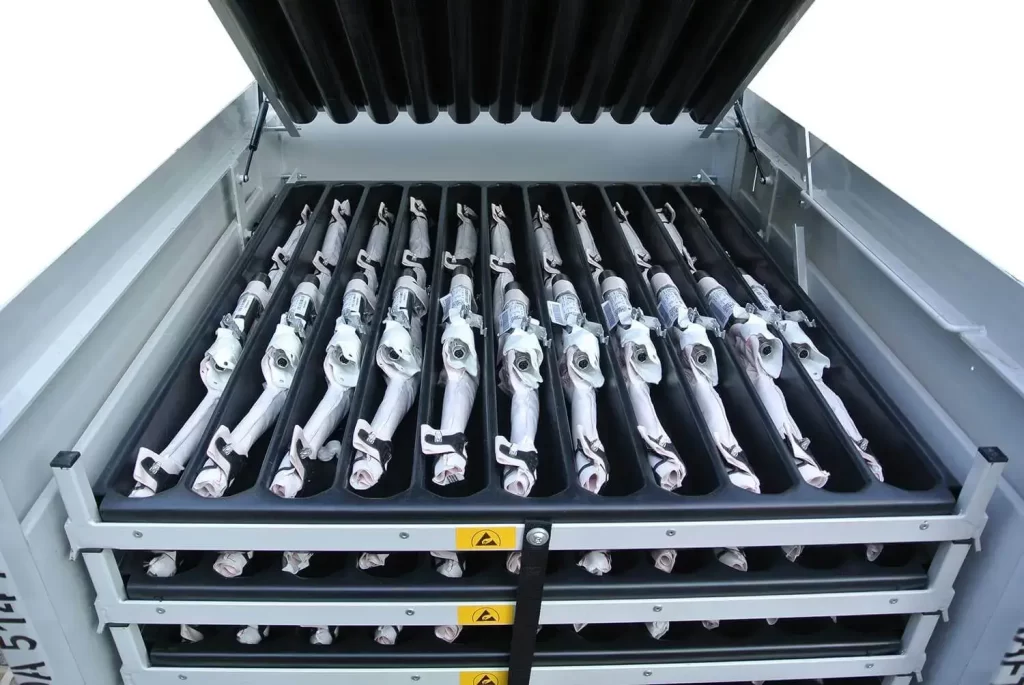
Transporting airbag modules and igniters is a separate category of challenges because they are classified as hazardous materials. Depending on their design, they fall under UN number 0503 (pyrotechnic safety devices, class 1.4G) or – if they meet the exclusion criteria confirmed by testing – under UN 3268 (electrically initiated safety devices, class 9). This classification carries specific obligations for the packaging.
Certified airbag container should meet a number of requirements: wear correct UN marking and transitions strength tests according to ADR requirements (including section 6.1 on the construction and testing of packaging) in an authorized laboratory, e.g. COBRO at the Łukasiewicz Institute of Technology in Łódź. This is not a formality – equipment for the transport of dangerous goods must undergo technical inspection and meet ADR requirements supervised by Transport Technical Supervision.
Reverse logistics in practice – how to organize the circulation of containers?
Purchasing a pool of containers is only half the battle – savings only materialize when the entire process runs smoothly. Well-organized reverse logistics is based on five steps:
- Pool inventory – counting the containers available and establishing the state standard, i.e. the minimum stock at the station.
- Rotation schedule – planning cycles and designating permanent return points to ensure that empty containers do not remain at the recipient’s disposal.
- Technical condition inspection – inspection and minor repairs after a specified number of cycles, before damage affects the safety of the load.
- Marking and identification – barcode, RFID tag or engraving, enabling tracking of each item; a standard is used to clearly identify returnable assets GS1's GRAI, i.e. Global Returnable Asset Identifier.
- Integration with systems – linking data with the supplier’s or recipient’s WMS/ERP, giving full control over the pool status.
The key advantage of metal structures over plastics is their ability to be repaired. A damaged container is subject to welding repairs, and the worn coating can be renewed by again hot-dip galvanizing – This extends the lifespan without having to replace the entire pool. This directly translates into lower long-term rotation costs.
Returnable packaging and EU regulations – what does the PPWR regulation change?
Until now, switching to returnable packaging was primarily a cost decision – now it is also becoming a matter of legal compliance. Regulation (EU) 2025/40 of the European Parliament and of the Council, known as the PPWR (Packaging and Packaging Waste Regulation), entered into force on 11 February 2025, and its main provisions will apply from 12 August 2026. As a regulation, it is directly applicable in all Member States, without the need for implementation into national law, and replaces the previous Packaging Directive.
For industrial manufacturers, the most important part is the transport packaging section. PPWR determines binding reuse targets – for many categories of transport packaging, the target level is 40% by 2030 and 70% by 2040 (with exemptions, including for cardboard packaging). The regulation also strengthens reverse logistics systems, requires packaging to be designed for multiple cycles, and limits empty space in transport packaging.
In practice, this means that reusable metal containers are no longer just a cost-cutting measure, but are becoming a key element in adapting the supply chain to upcoming requirements. Companies that implement them early will avoid time pressures and gain an advantage in negotiations with customers who hold suppliers accountable for environmental goals.
From inquiry to first delivery – how to order metal containers from Strumet?
Implementing your own returnable packaging system is easier than it seems. At Strumet, the process is a four-step process:
- Request for quotation – you provide dimensions, required load capacity, volume, working environment and any certification requirements.
- Selecting a solution – Strumet engineers offer a ready-made product from a series of types or an individual design.
- Optional prototype – if necessary, a test copy is created and tested under the conditions of your line.
- Serial production and delivery – after approval, we start the series and deliver a complete set of pools.
What sets Strumet apart? Our in-house galvanizing facility shortens lead times and lowers coating costs, as the entire process is conducted under one roof. We also offer quality assurances essential for the automotive industry: the EN 1090 certificate (factory production control for steel structures) and a welding quality certificate according to EN ISO 3834, as required by automotive manufacturers. TISAX information security assessment. This is complemented by comprehensiveness – from design, through welding, to galvanizing and logistics.
If you are looking for a partner who will provide reusable metal containers tailored to your production, check out our full offer transport and storage containers and send an inquiry – we will prepare a calculation tailored to your volume.
FAQ – frequently asked questions about reusable metal containers
How many cycles can a reusable metal container last?
A well-made galvanized steel container typically lasts over 100 rotations, and with regular inspections and welding repairs, many times more. The quality of the zinc coating and the supporting structure are crucial.
Can gitterbox be ordered to size and with non-standard dimensions?
Yes. When the standard series doesn't fit the dimensions of the part or the requirements of the line, Strumet designs and manufactures custom gitterboxes – from technical drawing to prototype.
What certificates are required to transport airbags in transport containers?
The container must be UN marked, undergo strength testing according to ADR requirements (including Chapter 6.1), and obtain confirmation of compliance from an authorized body. Classification depends on whether the module falls under UN 0503 (Class 1.4G) or UN 3268 (Class 9).
From what volume is it profitable to switch to returnable automotive packaging?
The transition pays off with consistent, repeatable turnover, where containers are quickly recycled. The higher the turnover rate, the faster the pool covers the investment, usually well before the container's lifespan expires. The exact threshold depends on the cost of disposable packaging, the turnover rate, and the cost of reverse logistics.
Do returnable metal containers help meet PPWR requirements?
Yes. The PPWR Regulation (EU 2025/40) promotes the reuse of packaging and sets targets for transport packaging in the coming years. Reusable metal containers meet these requirements because they are designed for repeated use, repair, and recycling.