For a steel structure working outdoors, the price of the coating is a fraction of the cost of replacing it later, so the choice of protection is decided at the level of the protection mechanism, not the rate per square meter. Hot-dip galvanizing bonds metallurgically with steel and protects it in two ways: as a barrier and cathodically, which for thicker elements means decades until the first maintenance in an industrial environment. Powder coating creates a purely barrier coating – inexpensive and aesthetic, but vulnerable to penetration, after which corrosion starts under the paint. The rest of the decision follows from this one distinction.
Two mechanisms of steel protection
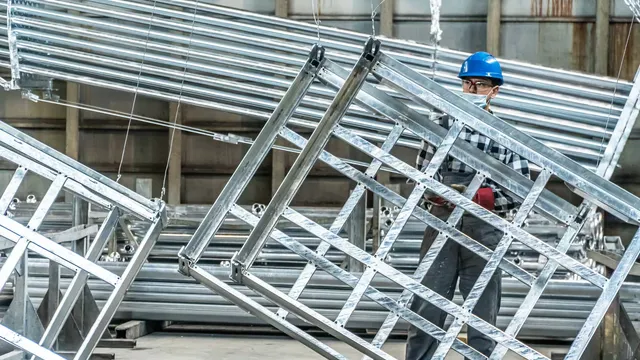
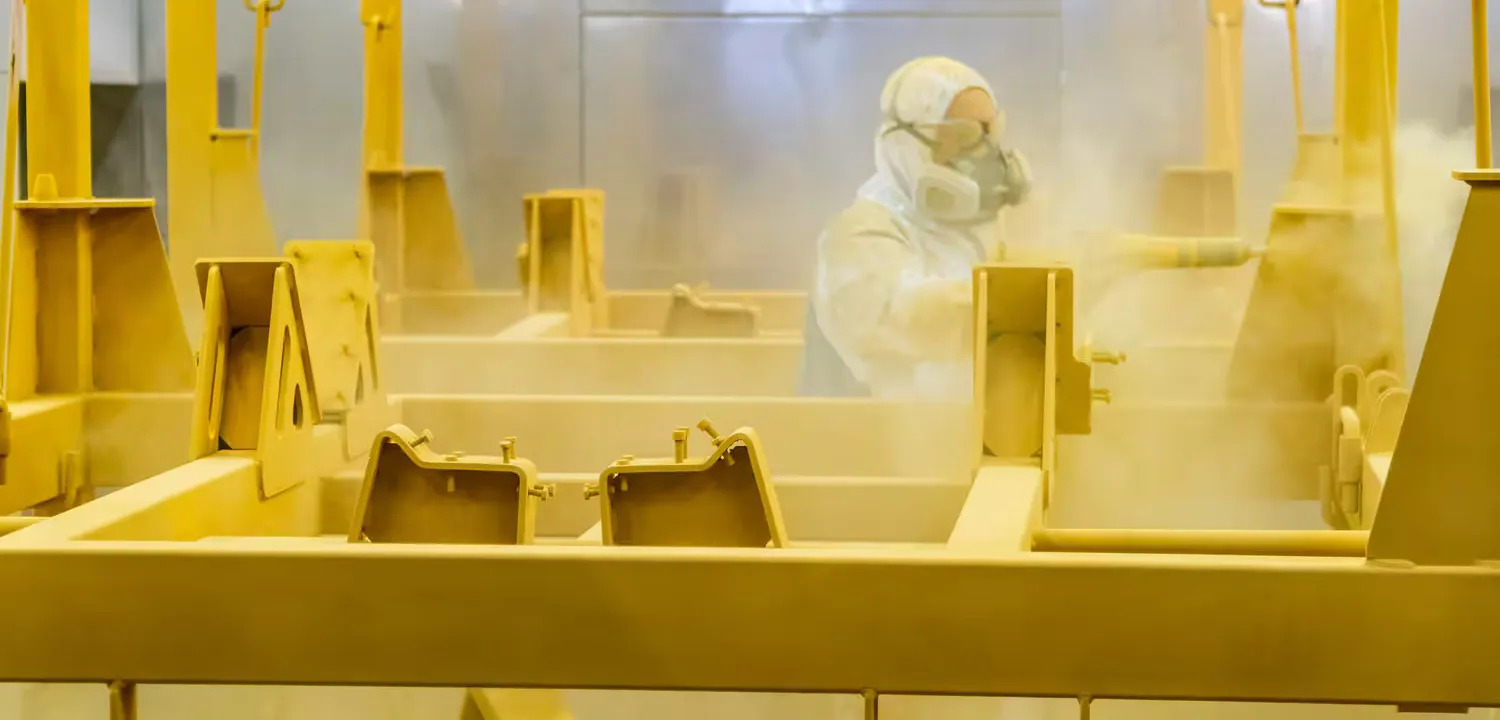
The difference between the methods begins at the level of the process itself. Hot-dip galvanizing involves immersing a cleaned element in a bath of molten zinc at approx. 450°C, where metallurgically bonded iron-zinc alloy layers form on the steel surface. Powder coating, on the other hand, is the electrostatic application of dry powder paint, which is then cured in an oven, forming a uniform polymer coating. This has practical significance, because the two methods protect steel in completely different ways: one works metallically and electrochemically, the other as a barrier.
Hot-dip galvanizing vs powder coating – the 10 most important differences
The comparison below evaluates both methods against the same criteria, based on standards (ISO 12944, ISO 1461) and in-service data. Instead of reading it linearly, it is worth starting with the criterion that is critical in your project – durability, corrosivity category or color – and checking how each method performs in that area.
| Criterion | Hot-dip galvanizing | Powder coating |
|---|---|---|
| Durability (years of protection) | Several decades, over 50 in favorable conditions | Typically 5–15 years, strongly dependent on the substrate and conditions |
| Coating thickness | Approx. 45–200 µm (per ISO 1461, depending on steel thickness) | Approx. 60–120 µm |
| Mechanical resistance | Very high – coating metallurgically bonded to the steel | Good, but prone to chipping and localized scratches |
| Corrosivity category (ISO 12944) | Up to C5, even CX in a duplex system | Mainly C1–C3, higher only in combined systems |
| Color and aesthetics | Limited – natural gray of zinc | Full RAL palette, various textures and gloss levels |
| Initial cost | Moderate, favorable for large batches | Competitive for smaller, decorative parts |
| Life-cycle cost (LCC) | Low – minimal maintenance costs | Higher with longer outdoor service |
| Maximum dimensions | Size of the bath, but double-dipping handles larger elements | Limited by the size of the oven and booth |
| Lead time | Short, single-stage process | Comparable, slightly longer for complex colors |
| Spot repairs | Possible (sprayed zinc, zinc-rich paints) | Difficult – requires repeating surface preparation |
In short: hot-dip galvanizing wins on durability and resistance in harsh conditions, while powder coating wins on aesthetics and freedom of color choice. The decision is most often determined by three aspects: durability, cost and design requirements.
Durability and corrosion resistance – a dozen years versus several decades of protection
The biggest difference between the methods lies in the protection mechanism. Hot-dip galvanizing provides both barrier protection (physically cutting the steel off from the environment) and cathodic protection – zinc, as a less noble metal, corrodes first, "sacrificing itself" and protecting the steel even where the coating is slightly damaged. It is precisely this dual mechanism that determines the exceptional durability of the zinc coating, measured in decades. According to data from the American Galvanizers Association, hot-dip galvanized steel thicker than 6 mm reaches approx. 72 years to first maintenance even in an industrial environment – the most corrosive one atmospherically.
"Time to first maintenance" (TFM) is defined as the point at which approx. 5% of the base steel surface has corroded – that is, when 95% of the zinc coating is still working. It is a conservative indicator of recommended servicing, not the point of complete coating consumption.
Powder coating protects for a shorter time and only as a barrier. As long as the coating is tight, the steel is safe, but any break in the paint (a scratch, a chip) opens the way to undercutting and delamination of the coating. Durability here depends largely on the coating thickness and the quality of substrate preparation.
The reference point for both methods is the corrosivity categories C1–C5 under the ISO 12944 standard. As the Institute of Corrosion organizes it, the scale for onshore structures covers five categories – from C1 (very low, e.g., heated air-conditioned rooms) to C5 (very high, e.g., a refinery in a coastal zone). The 2017 revision of the standard added the CX category – extreme environments, offshore and those with very high salinity, going beyond C5. For C4–C5 environments, hot-dip galvanizing is the natural choice, in category CX a duplex system becomes the standard, and powder coating on its own works mainly in categories C1–C3.
Cost of corrosion protection – one-time price versus life cycle (LCC)
Differences in the process translate directly into the cost structure. In hot-dip galvanizing, the element goes through degreasing, acid pickling and fluxing, followed by immersion in the zinc bath (at Strumet, the whole process is carried out in a professional hot-dip galvanizing plant adapted for large structures). The thickness of the zinc coating is not arbitrary here – the ISO 1461 standard ties the minimum zinc coating thickness to the thickness of the steel. Powder coating, in turn, is based on electrostatic spraying and oven curing.
When analyzing corrosion protection costs, it is worth looking not at the one-time price but at the entire life cycle. Hot-dip galvanizing is usually more advantageous for large steel structures – the higher initial outlay pays off thanks to minimal maintenance costs over decades. Powder coating can be price-competitive for smaller, decorative elements where appearance matters and operating conditions are not extreme. In practice, the choice comes down to a question: do you pay once for durability that lasts for years, or pay less for the visual effect, accepting the need for maintenance later?

Before you order protection – what to determine at the design stage?
Both methods impose requirements that are easier to meet on the drawing board than after the fact:
- Process holes – closed profiles and box elements intended for hot-dip galvanizing must have fill and vent holes so that molten zinc can flow in and drain freely, and trapped air does not burst the element in the bath.
- Risk of distortion – immersion in a bath at approx. 450°C introduces thermal stresses; thin, long or asymmetrical elements may distort slightly, which is worth taking into account already in the design.
- Steel composition and zinc coating appearance – the silicon and phosphorus content of the steel affects the thickness and color of the coating (the so-called Sandelin effect); hence the sometimes matte gray, thicker coatings on seemingly identical elements.
- Dimensions beyond the bath – elements longer than the galvanizing bath can be galvanized using the double-dipping method, so size is rarely a real barrier.
- Preparation for powder coating – the durability of a powder coating is based on substrate preparation (degreasing, conversion treatment); applying paint to a galvanized surface additionally requires dedicated treatment, described in the standards for duplex systems.
Duplex system: zinc and paint, or the synergy effect
To sum up, we recommend hot-dip galvanizing for large outdoor structures, for elements exposed to moisture, salt and mechanical damage, and wherever high corrosivity categories (C4–C5) are required: railings, steel structures, infrastructure elements, pallets and transport containers. Powder coating works well for elements where aesthetics, a specific color from the RAL palette or finish quality matter: interior details, metal furniture, enclosures, smaller decorative parts in milder conditions.
You do not always have to choose one at the expense of the other, however. For structures that are meant to be both as durable as possible and aesthetic, the best solution is a duplex system – hot-dip galvanizing as the base plus powder coating as the decorative layer and an additional barrier.
A synergy effect works here: the two coatings protect each other. The paint shields the zinc from wear, and the zinc protects the steel cathodically where the paint is damaged. According to data from the American Galvanizers Association, the durability of a duplex system is as much as 1.5–2.3 times higher than the sum of the service lives of both coatings used separately.
Strumet offers painting and galvanizing in one place, which simplifies logistics and lets you combine the durability of zinc with complete freedom of color. If you are choosing protection for a specific project, contact Strumet – we will select a method, or a combination of them, to suit the real operating conditions of your structure.
FAQ – the most common questions about powder coating vs hot-dip galvanizing
Can hot-dip galvanized steel also be powder coated?
Yes – this is the so-called duplex system. It does, however, require appropriate preparation of the galvanized surface before painting.
How many years does hot-dip galvanizing protect?
In typical conditions, the zinc coating protects steel for approx. 30 years, and in a less aggressive environment even for more than 50.
What is cheaper in the long run: hot-dip galvanizing or powder coating?
Over the life cycle of large outdoor structures, hot-dip galvanizing comes out cheaper thanks to minimal maintenance costs. Powder coating is usually cheaper up front, but with long outdoor service it generates the cost of renewing the coating.
Does powder coating protect against corrosion as effectively as galvanizing?
Not in all conditions – powder coating protects only as a barrier, so damage to the coating opens the way to corrosion. Zinc additionally works cathodically, which is why hot-dip galvanizing is more effective in high corrosivity categories.
Which steel elements are better protected by hot-dip galvanizing, and which by powder coating?
Hot-dip galvanizing is worth using for large outdoor structures and elements exposed to harsh conditions and damage. Powder coating works better for smaller details where color and aesthetics are important.