Corrosivity category C5 and a specific RAL shade in a single specification: today practically only one technology can satisfy that combination. Hot-dip zinc in this category is lost at a rate of up to 8.4 µm per year, so the standard 85 µm is used up within 10-20 years, and a matte gray surface will not pass anyway when a color is required. Duplex answers both requirements at once, provided that the buyer understands where the risk in this process lies and what to demand from the supplier.
What Is Duplex? Definition and Principle of Operation
Duplex is a corrosion protection system for steel that consists of applying a paint or powder coating to a surface previously hot-dip galvanized. The result is a two-layer system in which the paint acts as a barrier cutting zinc off from the aggressive environment, while zinc remains an active electrochemical protection for the steel. The two coatings do not work in parallel but mutually extend each other's service life - hence the effect is clearly better than when either is used alone.
It is worth clarifying the question of standards right away, because it is a source of misunderstandings in specifications. ISO 1461 describes only the zinc coating itself and explicitly excludes from its scope post-treatment and the application of additional coatings over zinc. Duplex is described by other documents: EN 15773 for powder coatings on galvanized steel, the ISO 12944 series for liquid paint systems, and the American practices ASTM D6386 (preparation for painting) and ASTM D7803 (preparation for powder coating).
The Limits of Protection by Zinc Alone - Environmental Corrosivity and Aesthetic Requirements
Hot-dip galvanizing is in most applications a self-sufficient solution. In a rural environment or a typical production hall, an 85 µm coating is lost at a rate of 0.1-0.7 µm per year and comfortably exceeds 100 years of durability. The problem appears where the annual zinc loss rises more than ten times: in an industrial atmosphere with sulfur dioxide, in coastal zones with high salinity, in wastewater treatment plants, near road de-icing brine and in chemical plants. The classification of these environments is set out in ISO 12944-2, and the rate of zinc loss and the resulting durability in ISO 14713-1 together with ISO 9223.
| Category | Example environment | Zinc loss [µm/year] | Durability of 85 µm zinc* | Is zinc alone sufficient? |
| C1 | Heated interiors with a clean atmosphere: offices, shops, hotels | up to 0.1 | Over 100 years | Yes, protection usually exceeds the need |
| C2 | Rural areas, low pollution | 0.1-0.7 | Over 100 years | Yes, with a large margin |
| C3 | Cities, plants with moderate emissions | 0.7-2.1 | 40 to over 100 years | Yes |
| C4 | Chemical plants, swimming pools, road salting zones | 2.1-4.2 | 20-40 years | Conditionally, duplex recommended |
| C5 | Heavy industry, coastal zone with high salinity | 4.2-8.4 | 10-20 years | Not for a long life cycle |
| CX | Offshore coastal zone, extreme industrial atmosphere | 8.4-25 | 3-10 years | No |
* Durability values count the time to first maintenance, not to perforation of the steel.
The second, equally common reason for choosing duplex is aesthetic requirements. The matte gray, uneven surface of zinc is sometimes unacceptable on facades, fences of public buildings, street furniture or architecturally exposed structures. Painting in a color from the RAL palette solves the visual problem, enables color coding of installations and at the same time postpones the moment of first maintenance.
3 Process Stages - From the Zinc Bath to the Cured Coating
A properly executed duplex consists of three closed stages, each with its own acceptance criteria. Omitting or shortening any of them does not show up immediately - the consequences are visible after the first or second season of service, when adhesion defects reveal themselves as blisters and chipping.
Stage 1: Hot-Dip Galvanizing
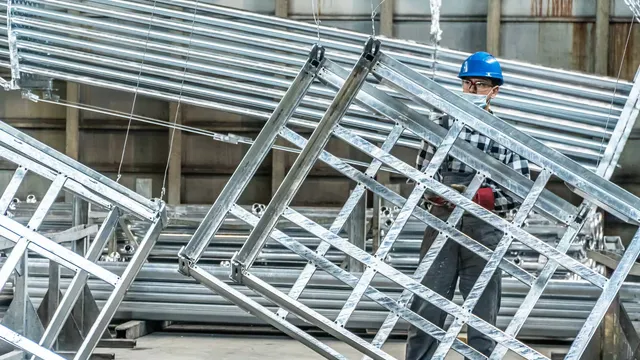
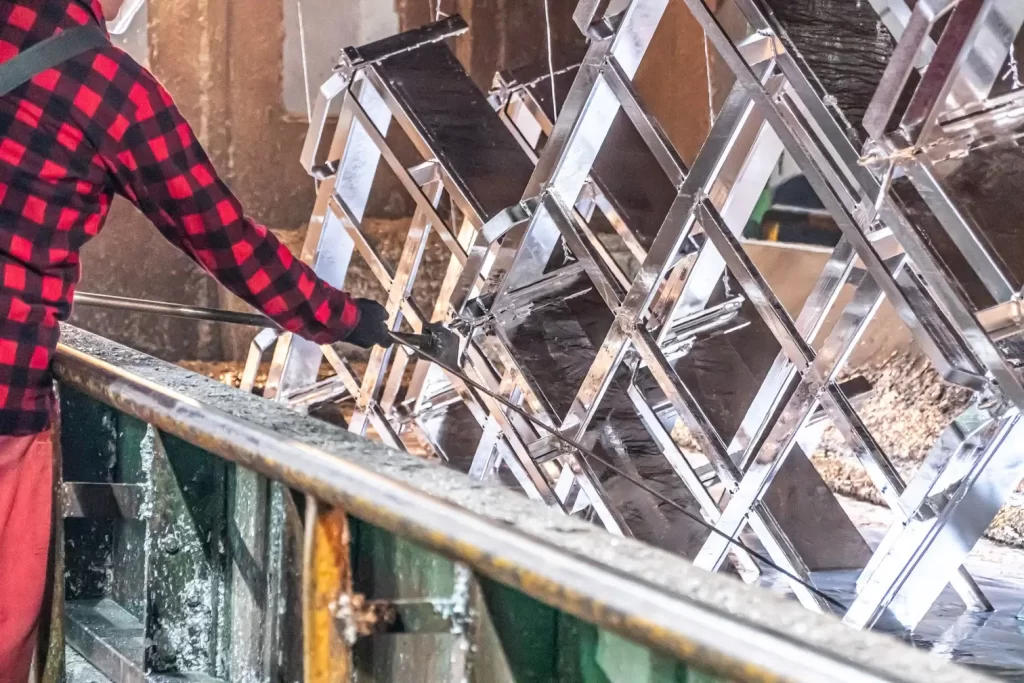
The starting point is identical to that of conventional galvanizing: degreasing, acid pickling, rinsing, fluxing and immersion in a zinc bath at a temperature of about 450°C, where a diffusion system of iron-zinc phases forms. We described the detailed course of the bath and the requirements for the part in the context of preparing steel for galvanizing - design rules, process holes and vents apply in duplex in exactly the same way.
Coating thickness is governed by ISO 1461: for steel components thicker than 6 mm the mean minimum is 85 µm and the local minimum 70 µm, with correspondingly less for thinner sections. In duplex this figure has additional significance, because the later sweep blasting removes a few micrometers of zinc, and the result after treatment must still fall within the requirements of the standard. When specifying duplex it is therefore worth ordering a coating with a margin above the minimum.
The steel composition is also important. A silicon content in the so-called Sandelin range produces thick, rough coatings prone to dusting, that is, a substrate on which it is hard to obtain repeatable paint adhesion. The conditions for accepting structures at the Strumet hot-dip galvanizing plant provide for a Si content below 0.03% or in the range of 0.15-0.25%, and the maximum dimensions of the part result from the working dimensions of the bath: 10.2 × 1.4 × 2.7 m.
Stage 2: Preparing the Zinc for Painting
Fresh zinc is chemically active, smooth and covered with residues from the baths - the paint has nothing to anchor to, and zinc corrosion products (so-called white rust) form a separating layer. ASTM D6386 and D7803 differentiate the procedure depending on the condition of the surface: fresh zinc is prepared one way, partially weathered zinc another, and fully weathered zinc yet another. The most troublesome is the intermediate state, in which a layer of zinc oxides and carbonates is already present but not yet stable.
The standard preparation sequence includes:
- Assessment and repair of the substrate - removing drips, zinc runs and sharp edges, checking for the absence of white rust.
- Degreasing - washing off oils, greases and transport residues with an alkaline detergent, followed by rinsing and thorough drying.
- Degassing bake - heating the part before powder coating so that moisture and gases trapped in the outer layer of the zinc coating evaporate before the paint is cured. Temperature guidelines are given in ASTM D7803; this step does not occur with liquid paint systems.
- Sweep blasting - light abrasive blasting with a non-metallic abrasive at low pressure (on the order of 0.2-0.3 MPa) and at an angle of 30-60°, so as to create a profile while removing only a few micrometers of zinc.
- Conversion treatment or primer - selected strictly according to the system's technical data sheet. With liquid paints D6386 permits reactive primers and acrylic passivation; with powder D7803 does not provide for them, and the scope of preparation is agreed with the powder supplier according to EN 15773.
- Painting within a defined time window - applying the layer within a few hours of preparation, before the surface re-oxidizes.
Skipping this stage is the most common cause of complaints in duplex - the coating looks flawless at acceptance and loses adhesion after the first thermal and humidity cycles.
Stage 3: Applying and Curing the Coating
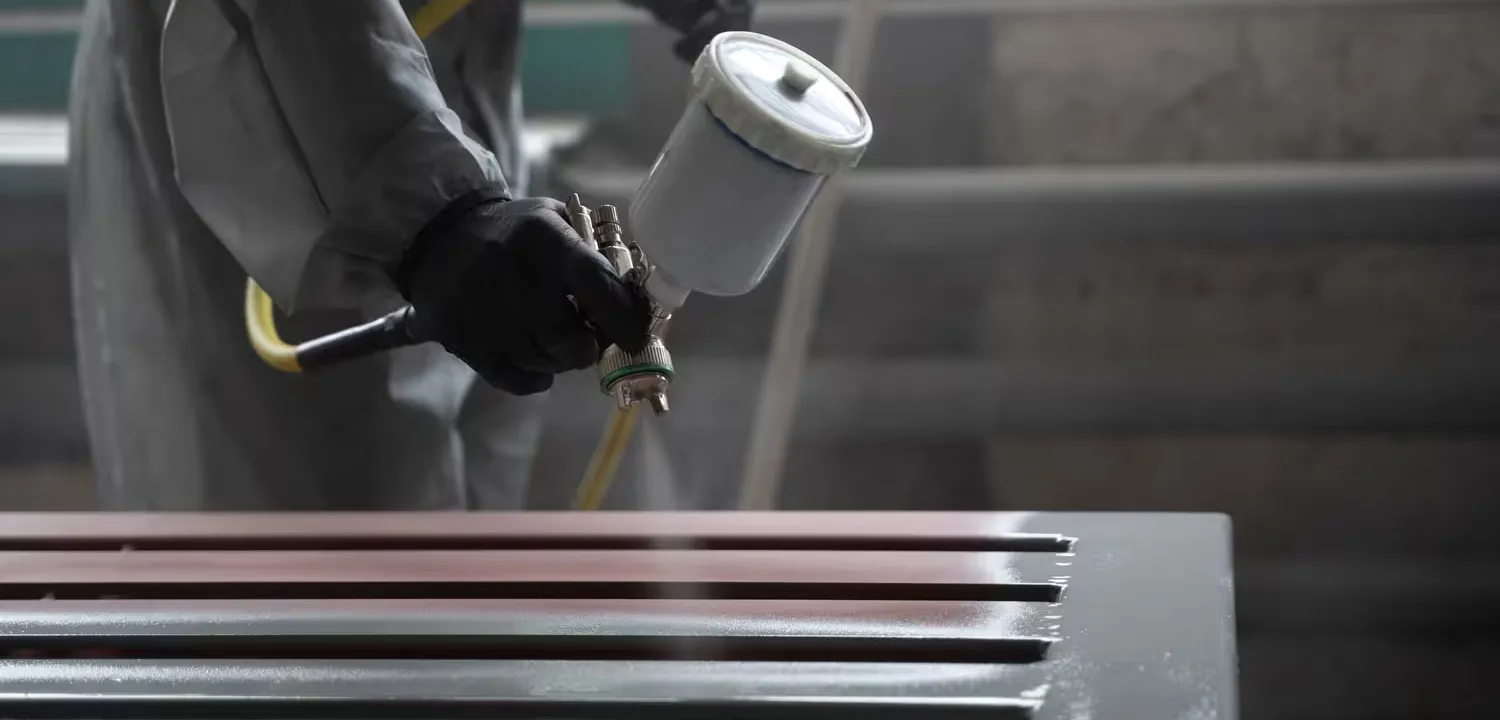
Powder paint is applied to the prepared zinc electrostatically, or a liquid system is sprayed on, usually in a primer and topcoat arrangement. The powder coating is cured in an oven at an object temperature of 180-200 °C for 10-20 minutes, counted from the moment the part reaches temperature, not from entering the oven - with thick sections the difference can be significant.
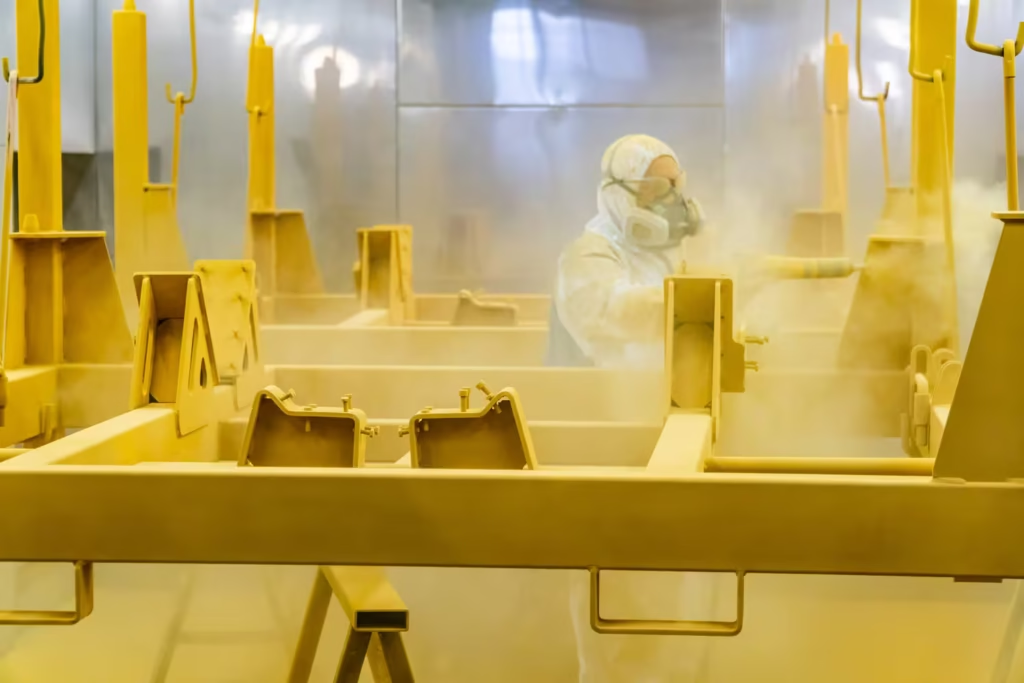
The paint system must be declared by the manufacturer as compatible with a zinc substrate. Alkyd paints react with zinc, forming zinc soaps and losing adhesion, so epoxy, polyester or polyurethane systems are used. When specifying, it is worth remembering that the ISO 12944 series excludes powder paints from its scope - for powders the reference points are EN 13438, EN 15773 and quality schemes such as Qualisteelcoat or GSB, while the corrosivity categories C1-CX remain the common language of both worlds.
The Synergy Effect - Why Does the Durability of Duplex Exceed the Sum of Both Coatings?
The mechanism works in both directions. The paint coating cuts zinc off from oxygen, moisture and pollutants, radically slowing its consumption - instead of losing several micrometers a year, the zinc remains practically untouched for as long as the paint stays intact. On the other hand, at places of mechanical damage to the paint, that is, scratches, chips from transport and assembly cuts, the exposed zinc acts cathodically toward the steel and prevents rust from creeping under the edge of the damage. The same scenario in a paint-only system ends with the coating peeling around the scratch.
Data from the American Galvanizers Association indicate protection 1.5-2.3 times longer than the sum of the durability of zinc and the paint coating counted separately, with a simultaneous extension of the paint maintenance cycle by 1.5-2 times compared with the same system on bare steel. In practice this means pushing back the first coating renovation by a dozen or so years.
The Most Common Mistakes and Challenges in Execution
Duplex defects rarely come from galvanizing alone or from painting alone, because both processes have their own well-described acceptance criteria. They arise at the interface of the technologies: in decisions about surface condition, the time window and the choice of paint system, that is, where none of the process standards works on its own. The trouble is that at acceptance the coating looks correct, and the defect shows up only after several thermal and humidity cycles, when the part is already installed.
The items below account for most complaints. Each of them can be eliminated at the request-for-quotation stage, at a much lower cost than later stripping and recreating the coating:
- Painting without surface preparation - paint applied to smooth, non-degreased zinc comes off in flakes. Always degreasing and sweep blasting, with an inspection record before painting.
- Incompatible paint system - alkyd products and some one-component products saponify on zinc. Require the paint supplier to provide a written declaration of suitability for a zinc substrate and a system matched to the target corrosivity category.
- Outgassing - moisture and gases trapped in the porous outer layer of the zinc coating evaporate in the oven, forming craters and blisters in the fresh paint. You can limit this with a degassing bake according to D7803, a degassing primer and paints with higher vapor permeability.
- Zinc too thin after treatment - sweep blasting removes material, so a coating ordered exactly at the ISO 1461 minimum may fall below the requirements after preparation. Allow a margin in thickness already at the inquiry stage.
- White rust in storage - galvanized parts stored in a damp, unventilated place become covered with zinc corrosion products that have to be removed mechanically. Store them with spacers, in a dry and airy place.
- Lack of coordination between plants - when the galvanizing plant and the paint shop do not jointly agree on the surface profile and the time window, responsibility for a defect becomes impossible to determine. The simplest approach is to entrust both stages to a single supplier.
Cost-Effectiveness and Pricing - 3 Considerations for Deciding to Use a Duplex System
The first is the corrosivity category. From C4 upward, duplex usually justifies itself in a life-cycle calculation; in C2-C3 rarely - there zinc alone will realistically last several decades and the additional layer is an investment mainly in appearance. The second is aesthetic and functional requirements: a RAL color, color coding of installations, matching the architecture or a requirement for a light-colored surface. The third is cost. Duplex raises the initial outlay, but for hard-to-access structures such as masts, trestles or structures above a production line, the saving from a single avoided renovation requiring scaffolding is often many times higher than the difference in the price of the protection. The AGA life-cycle cost calculator is useful for comparing scenarios over several decades.
At Strumet both stages are carried out at a single facility as part of industrial cooperation: hot-dip galvanizing and powder coating in a large-size manual paint shop and an automated line, with continuous adjustment of coating thickness from 60 to 150 µm. When planning a part for duplex, take both size limits into account: the galvanizing bath and the working space of the paint shop. The quote depends on part geometry, weight, required durability class and batch size, so it is closed fastest by a conversation about a specific drawing - send us the specification, and we will prepare an offer together with a recommendation of the coating system.
FAQ - Most Frequently Asked Questions About the Duplex System
Can duplex be applied to a structure that is already galvanized?
Yes, this is a typical case. It does, however, require an assessment of the condition of the zinc coating, removal of white rust and full surface preparation. Fully weathered zinc is often a more forgiving substrate for painting than a coating in the intermediate state, where a layer of corrosion products is already present but not yet stable.
How many years does duplex protect compared with hot-dip galvanizing alone?
Durability is usually 1.5-2.3 times more than the sum of the durability of zinc and the paint coating counted separately. In a C4 environment this most often means going from 20-40 years to a durability exceeding the life cycle of a typical industrial installation.
Does powder paint adhere well to a galvanized surface?
Yes, provided the substrate is properly prepared and a powder dedicated to zinc is selected. Without degreasing, a degassing bake and sweep blasting, adhesion is uncertain regardless of the quality of the paint.
What RAL color can be chosen when opting for duplex?
Practically any from the RAL palette, in matte, semi-gloss and textured variants. For unusual shades and small batches, powder availability and the paint manufacturer's minimum order quantity are decisive.
How much does duplex cost compared with hot-dip galvanizing alone?
The cost is clearly higher, because surface preparation, paint material and curing are added. The scale of the difference depends on part geometry and batch size, and the calculation is best done over the life cycle, taking into account the cost of access to the structure during future renovations.