When a bare, uncoated spot appears on a galvanized element, the cause is almost never to be found in the zinc bath. Liquid zinc reacts only with clean iron - it will bond neither to mill scale nor to rust. A few square centimeters of unremoved oxide are enough to create an uncoated area at that spot. Whether the steel enters the bath properly prepared is decided by steel pickling. We explain what it involves, how it proceeds, and why it determines the durability of the entire coating.
What Is Steel Pickling?
Steel pickling is a chemical process of removing from the metal surface the layers formed during production and storage. Each of them interferes with further processing:
- mill scale - a hard layer of iron oxides formed during hot rolling;
- rust - a product of corrosion, that is, the reaction of iron with oxygen and moisture;
- oxides and discoloration - thin layers formed, among other things, after thermal cutting and welding.
Pickling itself involves immersing elements in an acid bath that dissolves these contaminants and exposes clean, metallic material. The goal is to bring the surface to a state in which subsequent processes - galvanizing, painting, or applying other coatings - have direct contact with the metal rather than with a layer of contaminants.
Pickling as a Surface Preparation Stage Before Hot-Dip Galvanizing
In hot-dip galvanizing technology, pickling is not a stand-alone operation but one of the links in a strictly ordered process chain. The standard sequence looks as follows:
- Degreasing - removal of oils, greases, and organic contaminants, which acid does not dissolve.
- Pickling - dissolving rust and mill scale in an acid bath.
- Rinsing - washing off residual acid and iron salts so that they are not carried over into subsequent baths.
- Fluxing - application of a flux (most often zinc ammonium chloride), which protects the clean surface from re-oxidation and improves wetting by zinc.
- Galvanizing - immersion in liquid zinc at about 450°C, where the alloying reaction of iron with zinc takes place.
The quality of pickling determines the adhesion of the zinc. The alloying reaction takes place only on exposed metal - if islands of mill scale or rust remain on the surface, zinc will not bond in those places. The expected degree of substrate cleanliness is described by the standards in the PN-EN ISO 8501 series.

How Does Pickling Proceed? Methods and Pickling Baths
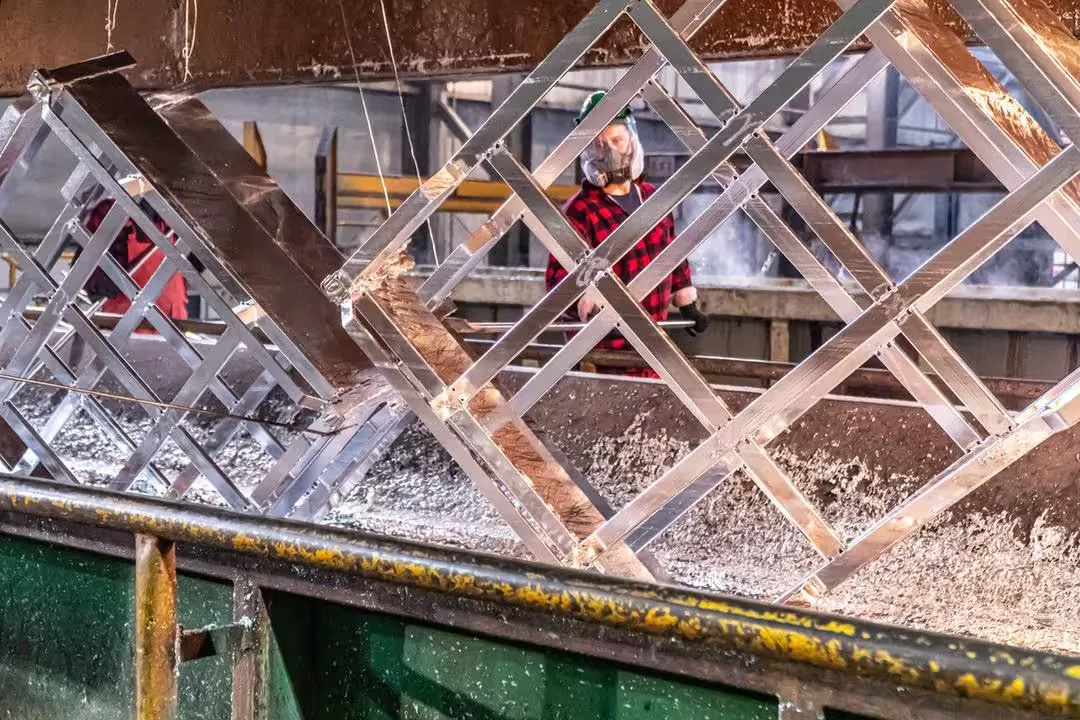
In industrial practice, pickling is most often carried out by the immersion method - structures are immersed in tanks containing an acid solution. The effectiveness and duration of the process are determined by the type of acid, its concentration, and the bath temperature.
Two acids are encountered in hot-dip galvanizing plants:
| Parameter | Hydrochloric acid (HCl) | Sulfuric acid (H₂SO₄) |
| Working temperature | Usually ambient temperature | Elevated (approx. 60-80°C) |
| Pickling speed | High | Requires heating the bath |
| Surface finish | Smoother, cleaner | Greater risk of over-pickling |
| Prevalence | Standard in galvanizing | Less common, mainly historically |
Pickling time depends on the condition of the material - lightly rusted steel comes clean in a few to a dozen or so minutes, while heavily corroded steel requires a much longer immersion. To protect sound metal from excessive dissolving and to limit so-called hydrogen embrittlement, inhibitors are added to the bath - compounds that slow the reaction of the acid with clean iron but do not hinder the dissolving of rust and mill scale. Spent baths require monitoring of the iron concentration and periodic regeneration or replacement.
Pickling of Stainless Steel
At this point it is worth clearly separating two contexts. Everything above concerns carbon (black) steel being prepared for galvanizing. Pickling of stainless steel (inox) is a separate process - carried out for a different purpose and with different acids, because stainless steel is not galvanized. The aim here is to restore corrosion resistance and the aesthetics of the surface. Immersion pickling of stainless steel, that is, immersing the entire element in a bath, works well for smaller parts and allows complex shapes to be treated evenly.
For pickling inox, a mixture of nitric acid (HNO₃) and hydrofluoric acid (HF) is usually used - in the form of baths, pastes, or gels. The international reference point for cleaning, pickling, and passivation of stainless steel is the practice of ASTM A380.
Pickling Stainless Steel After Welding
In the weld area, high temperature causes the formation of weld discoloration (heat tint) and chromium depletion of the surface layer. That is precisely where stainless steel corrodes most easily. Pickling stainless steel after welding removes the discoloration and the damaged layer, exposing homogeneous material with full corrosion resistance.
Pickling and the Quality of the Zinc Coating
Returning to galvanizing - this is where the entire logic of the process closes. A zinc coating will be only as good as the surface it lands on. A poorly prepared substrate means areas not covered with zinc, weaker adhesion, and as a result faster corrosion.
The requirements for finished dip-applied zinc coatings are defined by the PN-EN ISO 1461 standard - it specifies, among other things, the minimum coating thicknesses and the criteria for assessing them. Design guidelines and the predicted durability of coatings in various environments, in turn, are collected in PN-EN ISO 14713-1. Meeting these requirements, however, begins long before the zinc bath, right at the pickling stage. That is why in a professional plant - such as Strumet - surface preparation is treated as seriously as galvanizing itself.
FAQ - Most Common Questions About Steel Pickling
What is the difference between pickling and passivation?
Pickling removes mill scale, rust, and the depleted layer of metal from the surface, while passivation rebuilds the protective layer of oxides (in stainless steel - chromium oxides). Pickling cleans, passivation protects - they are often applied one after the other.
What acids are used for pickling steel?
For carbon steel, most often hydrochloric acid, less often sulfuric. Stainless steel is pickled with a mixture of nitric and hydrofluoric acids.
How does pickling of stainless steel after welding proceed?
The element, or just the weld zone, is exposed to an acid bath, paste, or gel that dissolves the heat tint and the damaged layer. After pickling, the surface is thoroughly rinsed and usually additionally passivated.
What happens to steel if it is poorly pickled before galvanizing?
In places with residual mill scale or rust, zinc will not bond, resulting in uncoated areas and zones of poor adhesion. The coating is then non-uniform and fails faster, which lowers the durability of the entire structure.