You receive two quotes for protecting the same batch of components. Both offers talk about "zinc plating," and the price difference is several-fold. Behind this lies a choice between technologies: hot-dip galvanizing gives a very durable coating several dozen micrometers thick, while zinc electroplating gives a layer several times thinner, but smooth, repeatable and without changing the dimensions of the part. Find out where this difference comes from and how to match the method to your component.
In Short: What Is the Difference Between Zinc Electroplating and Hot-Dip Galvanizing?
Before going into the details of both technologies, here are the parameters that most often decide the choice.
| Parameter | Zinc electroplating | Hot-dip galvanizing |
| Mechanism | Electrolytic deposition of zinc from an aqueous bath | Immersion in liquid zinc and Fe-Zn diffusion reaction |
| Process temperature | Room temperature | Approx. 445-455°C (high-temperature up to approx. 560°C) |
| Typical coating thickness | 3-25 µm | 50-100 µm and more |
| Bonding to the substrate | Deposited on the surface | Iron-zinc alloy layers |
| Appearance | Smooth, uniform, colored passivation possible | Matte or shiny, non-uniformities acceptable |
| Dimensional accuracy | Very high, threads keep their tolerances | Limited, risk of distortion of thin parts |
| Part size | Small and medium-sized components | From small parts to large-size structures |
| Reference standard | PN-EN ISO 2081 | PN-EN ISO 1461 |
The remaining differences follow from the first two rows of the table. Temperature determines whether zinc settles on the surface or bonds with the steel, and the method of application determines the thickness, which translates directly into years of protection.
Zinc Electroplating Step by Step
Zinc electroplating, also called electrolytic zinc plating or colloquially galvanizing, involves depositing zinc from a solution with the aid of direct current. The entire process takes place at room temperature, and its advantage is control over coating thickness and appearance with an accuracy that the immersion method does not offer.
The Electroplating Process
The part goes in turn through degreasing, pickling and rinsing, and then into the electrolytic bath, where it acts as the cathode. When voltage is applied, zinc ions migrate to its surface and are deposited as a compact metal layer. The process is carried out at room temperature, so the structure and hardness of the substrate remain intact.
The quality of the coating here is determined not by its thickness alone but by the composition of the electroplating bath. Zinc ion concentration, electrolyte pH, current density and organic additives determine whether the layer will be fine-grained and compact or porous.
The coating is then subjected to passivation, that is, a conversion treatment that slows the appearance of white corrosion products.
With high-strength steels, electrolysis carries a risk of introducing hydrogen into the material, which is why fasteners of class 10.9 and higher require stress-relief baking immediately after coating.

What Does Hot-Dip (Immersion) Galvanizing Involve?
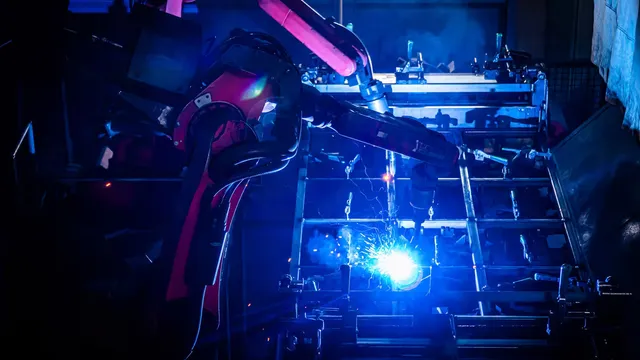
Hot-dip galvanizing (you may also come across the name immersion metallizing) works on a completely different principle. Instead of depositing zinc on the surface, it triggers a reaction between the steel and the liquid metal and builds the coating from the inside out.
The Metallurgical Reaction
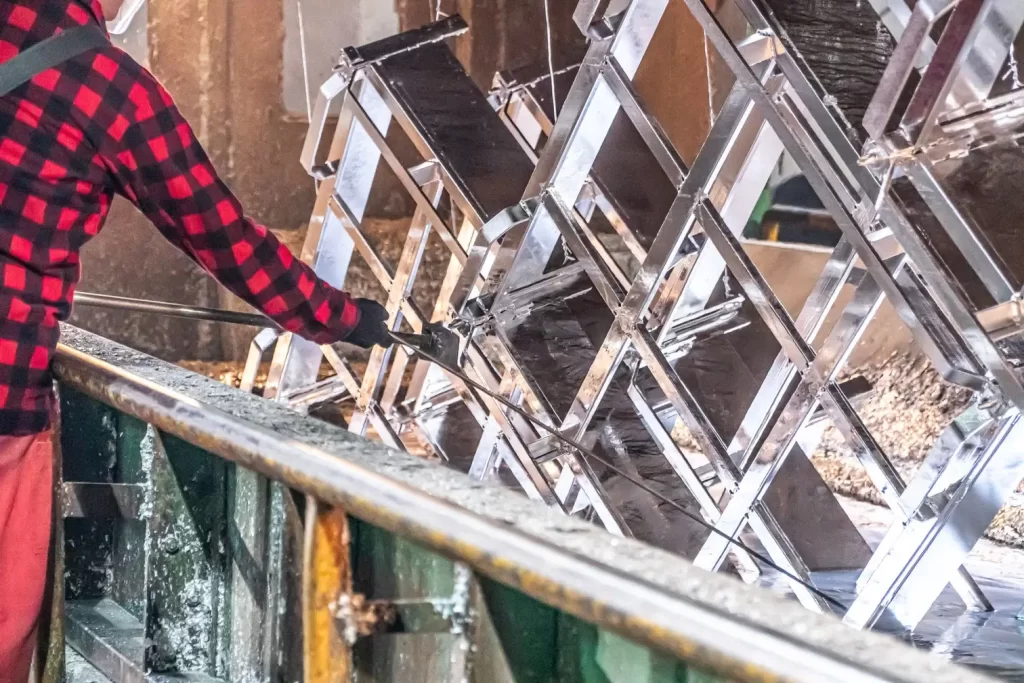
After degreasing, pickling and fluxing, the component is immersed in a bath of liquid zinc. There, diffusion of iron and zinc takes place. A system of Fe-Zn alloy layers forms, growing from the steel side and covered by a layer of pure zinc. The deepest alloy layers can be harder than the substrate steel itself - and they are responsible for the resistance of the zinc coating to abrasion and impact.
Zinc Coating Thickness - What Does It Depend On?
At a hot-dip galvanizing plant you do not order coating thickness the way you do at an electroplating shop. Layer growth results from the wall thickness and composition of the steel, above all the silicon content. The Polish Galvanizers Association states that for components with a wall thickness above 6 mm made of S235 steel with a silicon content of 0.14-0.25%, the mean minimum coating thickness is at least 85 µm. The process runs most favorably at a silicon content below 0.03%, whereas the ranges of 0.03-0.14% and above 0.25% are not recommended, because the iron-zinc reaction can proceed violently and the share of alloy layers will exceed the values provided for by the standard.
Hot-Dip Galvanizing vs. Electroplating - Coating Durability in Practice
Durability is calculated simply: coating thickness divided by the annual zinc loss in a given environment. Environments are classified by PN-EN ISO 12944-2 on a scale from C1 to C5, and the rate of loss is given by PN-EN ISO 14713-1. In a C3 environment the annual loss of zinc coating thickness reaches up to 2 µm, so an 85 µm coating provides at least 40 years of protection without additional maintenance. Plug a 12 µm electroplated coating into the same calculation, and you get a few years instead of several decades.
The second factor is behavior after damage. Both coatings protect steel cathodically: zinc, as the more active metal, corrodes instead of iron, so a scratch does not become a focus of rust. With a hot-dip coating, however, the reserve of zinc around the scratch is several times greater.
Applications - When Electroplating and When Hot-Dip?
In practice the division runs along two axes: the size of the part and the environment in which it will operate.
Zinc Electroplating - Typical Products
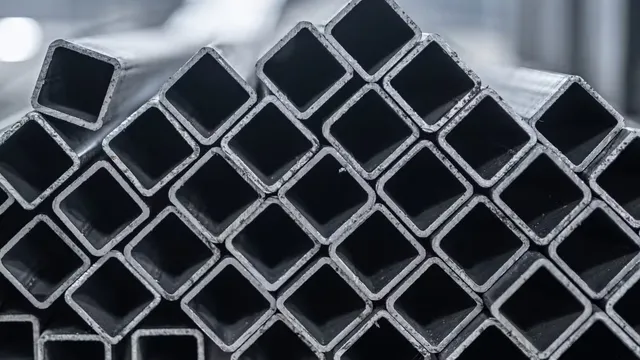
The electroplating line mainly receives small, precise and visible parts operating in conditions of low corrosive aggressiveness. These are most often:
- fasteners: bolts, nuts, washers, springs, where the thread must keep its tolerance,
- parts with complex geometry, barrel-plated in large batches,
- visible parts, where a smooth surface and passivation in blue or iridescent yellow matter,
- automotive, household appliance, furniture and electrical components operating indoors.
Structures for the Hot-Dip Line
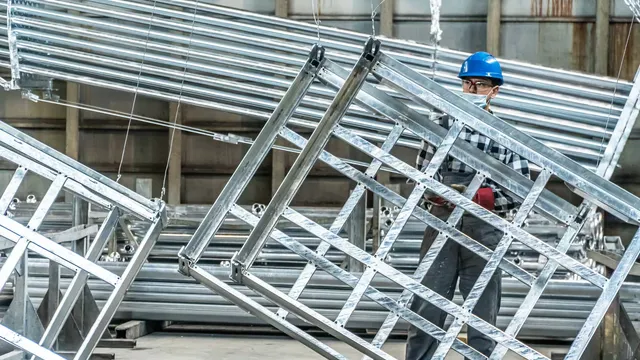
The hot-dip galvanizing plant accepts components of greater weight and size, exposed to weather and mechanical loads. Typically these are:
- steel structures, columns, trusses, trestles, road infrastructure elements,
- railings, fences, stairs and platforms operating outdoors,
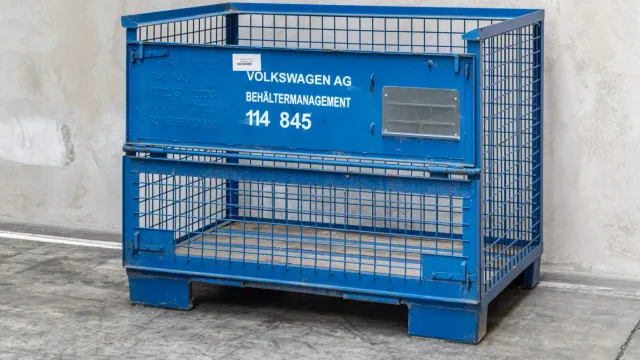
- transport and storage containers, including Gitterbox mesh boxes,
- elements exposed to abrasion and mechanical loads that are meant to work without maintenance for decades.
Other Types of Zinc Coating: Thermal Spraying, Sherardizing, Zinc Flake
Hot-dip and electroplated zinc cover most orders, but they do not exhaust the list of available technologies. In specific applications, other methods are used:
- Thermal spraying - molten zinc applied with a stream of compressed air, to components that cannot be immersed.
- Diffusion galvanizing (sherardizing) - treatment in zinc dust, giving an even layer on complex shapes.
- Zinc flake - a non-electrolytic coating per PN-EN ISO 10683, without the risk of hydrogen embrittlement, popular in the automotive industry.
- Continuously galvanized sheet - galvanizing of strip before the product is formed.
We discuss them in more detail in our guide to types of metal galvanizing.
Electroplated or Hot-Dip Zinc? 6 Questions Before You Decide
- Where will the component operate? Inside a heated building, electroplated zinc is enough. Outdoors, next to a road salted in winter or in an industrial atmosphere, choose hot-dip galvanizing.
- What are the tolerances? A thread, a tight fit, a precision hole - electroplated zinc.
- What size and weight? Large and heavy structures go only through the hot-dip galvanizing plant.
- What steel? Before hot-dip galvanizing check the silicon content, and for classes 10.9 and higher plan baking after electroplating.
- Will the component be painted? Consider the duplex system.
- What is the service horizon? At 30 years or more, the life-cycle cost calculation comes out in favor of hot-dip zinc.
Strumet runs both technologies: the largest hot-dip galvanizing plant in the Podbeskidzie region and a fully automated electroplating shop, with rack and barrel lines and its own analytical laboratory. For the customer this is convenient insofar as in a single project the two methods often complement each other: the structure goes to the hot-dip line, and the hardware and fasteners to the electroplating bath.
For more details and a quote, please contact us. We have 30 years of experience in the industry, an advanced machine park and excellent specialists who will select the optimal method for every component.
FAQ - Most Frequently Asked Questions About Electroplated vs. Hot-Dip Zinc
Does electroplated zinc rust?
Zinc does not oxidize the way steel does, but it is consumed, and once the layer is used up, rust appears on the substrate. At 3-25 µm outdoors, this can happen relatively quickly.
How many years will hot-dip zinc last, and how many electroplated zinc?
A hot-dip coating 85 µm thick in category C3 gives at least 40 years to first maintenance. The durability of an electroplated coating in the same environment is counted in years rather than decades.
Which is more expensive: zinc electroplating or hot-dip galvanizing?
For small parts, the unit price of electroplated zinc is as a rule lower. However, when it comes to outdoor structures, hot-dip zinc comes out better in a life-cycle calculation, because it requires no maintenance.
Can the galvanizing method be recognized by appearance?
An electroplated coating is smooth and uniform, often with iridescent passivation. A hot-dip coating is usually matte, with a visible crystallization pattern and a thicker edge at holes.
Can a zinc coating be painted?
Yes, after appropriate surface preparation. The combination of zinc and paint gives a duplex system with a service life greater than the sum of both coatings separately.