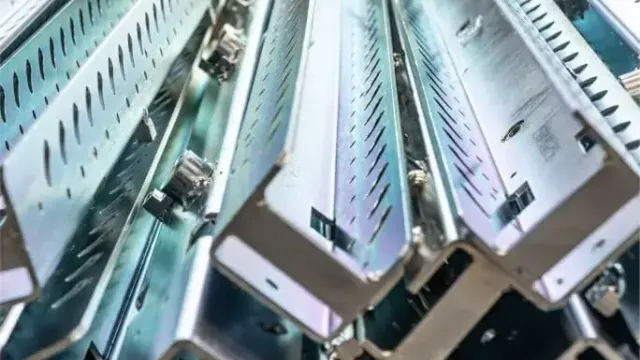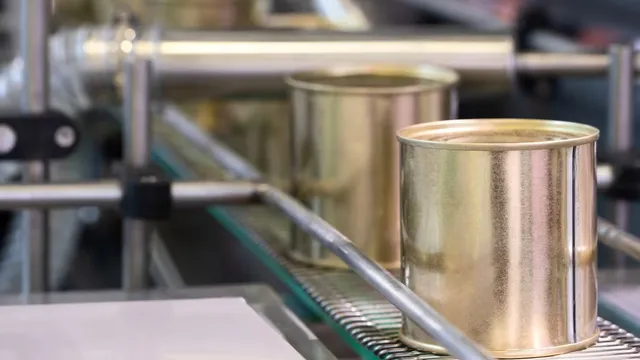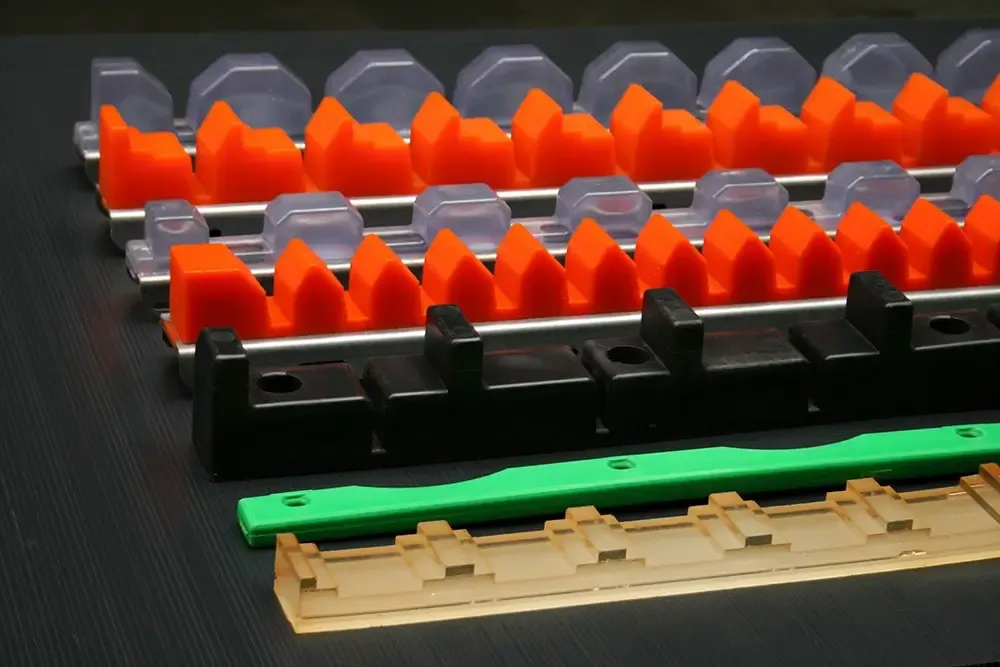
Polyurethane casting is a technology for producing PU elastomer components by gravity-pouring a mixture of prepolymer and chain extender into molds. It is used where steel wears too quickly, rubber loses its shape too quickly, and the production volume does not justify a steel injection mold.
This text is a technical overview for design engineers, process engineers and buyers of returnable packaging. We discuss the difference between cold and hot casting, the properties that matter in service, the selection of hardness for the function of the component and the criteria for deciding on a custom-made insert. We give parameters in the form in which they go into a request for quotation.
Polyurethane casting – what kind of technology is it and how does it differ from injection molding?
Polyurethane casting is a process in which a liquid prepolymer (the product of the reaction of a diisocyanate with a polyol) is mixed with a chain extender – a diamine or a diol – and gravity-poured into a mold, where the mixture cross-links into an elastomer of a specified hardness. There is no high injection pressure, pressing or vulcanization here.
In workshop practice, two variants of the process are distinguished:
- Cold casting – mixing and pouring at ambient temperature, into simple open molds made of plastic or aluminum; this is the method used by the Strumet polyurethane casting shop.
- Hot casting – prepolymer and curing agent heated to around 80–110°C, a temperature-controlled mold, longer curing; chosen for systems with the highest abrasion resistance and larger sizes.
For the buyer, what is key compared with injection molding is above all the economic difference, and the technological one only second.
| Criterion | PU casting | Plastics injection molding |
| Mold cost | Low (plastic, aluminum) | High (hardened steel) |
| Cost-effective run | From single pieces to several thousand | From several thousand upward |
| Geometry and size | Large, thick-walled, flexible parts | Precise, thin-walled, rigid |
| Dimensional tolerances | Moderate (shrinkage depends on the formulation and thickness) | Tight and repeatable |
| Tooling lead time | Days | Weeks |
For large volumes and repeatable parts, series production on an injection molding machine makes more sense – the two technologies complement each other. It is also worth remembering that the casting shop can work with a mold supplied by the customer, which shortens the path to the first batch if the tooling already exists.
Properties of polyurethane elastomers that matter in industry
Polyurethane elastomers occupy an unusual place between rubber and engineering plastic – they have the elasticity of rubber and a strength close to that of hard plastics. In practice, 5 characteristics count:
- Abrasion resistance – usually markedly higher than that of typical technical rubbers at comparable hardness.
- High rebound and shape recovery after unloading.
- Low compression set – it decides whether, after two years, the pocket still positions the part in the same place.
- Resistance to oils, greases, many solvents and UV radiation.
- Vibration damping and absorption of impact energy.
The limit is set by temperature. Standard PU castings work in the range from about -30 to +80°C, so washing in hot alkaline baths or proximity to a paint-curing oven must be flagged already at the request-for-quotation stage.
What is key is easy to overlook when ordering: durability is determined not by hardness, but by the chemistry of the formulation. Research on the abrasion resistance of segmented polyurethane elastomers based on different polyols (Kwiatkowski, Nachman, "Polymers" 2017) shows that materials of the same hardness can differ in abrasive wear by as much as a factor of twenty, and this is decided by the structure of the soft segment – in that study, systems based on polyester polyols performed best. That is why, for castings working in contact with the sharp edge of a part, the question "how many Shore points?" is secondary to the question "based on which polyol and with which chain extender?".
Polyethers, in turn, win where hydrolysis resistance matters: in a humid environment, with contact with water and washing with detergents, polyester systems degrade faster. The choice between one type of polyol and the other is usually a compromise between abrasion resistance and water resistance – and it is this that should be the subject of the conversation with the supplier.
If abrasion resistance is to be a contractual parameter, it is worth citing the test method. Volume loss on an abrasive drum is described by the ISO 4649 standard, which itself cautions, however, that the results should not be translated directly into service life – they are used to compare materials with one another, not to forecast the number of circulation cycles.
Selecting hardness (Shore A) for the application
The rule is simple: the more the element is meant to cushion, the softer the casting.
| Hardness range | Typical application |
| 30–50 ShA | Soft, strongly damping inserts for particularly delicate surfaces |
| 50–70 ShA | Pockets and inserts for painted and machined parts |
| 70–90 ShA | Guide elements, bumpers, loaded pockets, liners exposed to abrasion |
| above 90 ShA (Shore D scale) | Load-bearing elements, bushings, slides – already a different material area |
The Strumet casting shop covers the range of 30–90 ShA, which covers practically all applications in transport tooling.
The reference point for the whole industry is standardized Shore hardness measurements according to ISO 48-4 and ASTM D2240, which define the indenter geometry and the reading conditions – without citing a standard, a value of "70 Shore" in a request for quotation is ambiguous.
Applications of polyurethane casting in industry – an overview of industries and components
Custom polyurethane castings most often go where steel wears too quickly and rubber loses its shape:
- Production rollers and rolls – PU-coated transport, drive and pressure rollers in packaging lines and in paper and sheet metal processing.
- Seals and bushings – rings, glands, guide bushings and sliding elements resistant to hydraulic oils.
- Wheels and tires – tires for transport carts, running wheels and support rollers, quiet and non-marking on floors.
- Abrasion-resistant liners – linings of chutes, bins, cyclones and screw conveyors in the agricultural and processing industries.
- Screens and screening machine elements – where steel screens wear out in no time and noise is a problem.
- Machine and tooling elements – shock absorbers, bumpers, locating pockets, gripper jaws, suspension elements.
- Inserts and pockets in transport tooling – for automotive, rail, defense and agricultural industries, where the part must arrive without scuffs.
It is worth adding that the casting can be pigmented. In returnable logistics, the color of the insert is often the simplest way to mark a part variant or the revision number of the tooling.

Polyurethane inserts for transport containers – how does Strumet design and produce them?
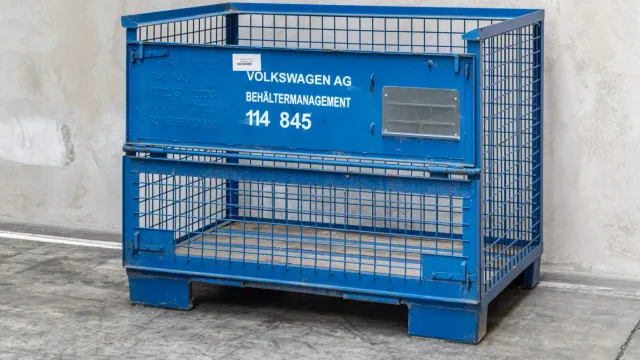
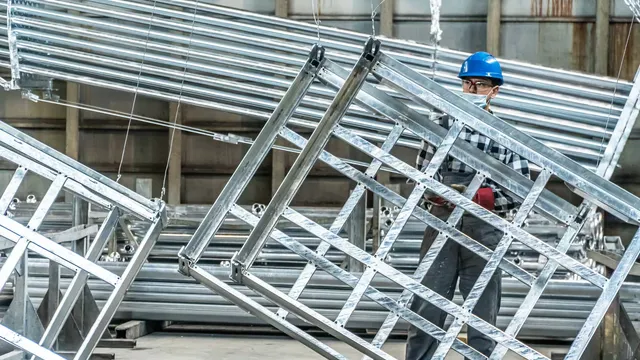
Usually one plant welds and galvanizes the steel structure of the container, while another – independent – casts the polyurethane insert. Responsibility for the fit is diluted between two suppliers, and every correction of the geometry means another iteration between companies. At Strumet, both of these happen under one roof: the production of transport and storage containers, corrosion protection and polyurethane casting are parts of the same process.
The course of a project looks like this:
- Input – a 3D model or the customer's physical part, together with information on which surfaces are critical (paint, machined surfaces, threads), what the weight of the part is and how many circulation cycles per year the container makes.
- Pocket and mold design – the shape of the pocket, taking into account shrinkage, draft angles and an allowance around the outline of the part.
- Selection of the PU system – hardness, type of polyol and chain extender, chosen for abrasion, washing and operating temperature.
- Casting and curing – pouring the mold, cross-linking, curing until the target mechanical properties are reached.
- Assembly – onto the frame, strip or base of a metal container, or into Gitterbox mesh boxes.
Because the steel structure is made in the same plant, the insert's attachment points are designed together with the container, not added later. As a result, inserts are replaceable: after years of use, a worn insert is replaced without touching the steel frame, and the level of part protection returns to the original. For customers from the automotive and rail industries, the system environment is also often important – Strumet operates under ISO 9001, with TISAX certification and EN 15085 for welding of rail vehicles.
Polyurethane inserts versus other methods of protecting components in transport
Choosing protection is a calculation over the entire life cycle of returnable packaging, counted in dozens of circulation cycles. The industry verifies this choice in the laboratory – the methodology for testing packaging and transport systems, covering drops, vibration and compression, is described by the ASTM D4169 standard, and it is against such a distribution scenario that solutions are worth comparing.
| Criterion | PU insert | Foam (PE/PU) | Textile insert | Rubber liner |
| Number of circulation cycles | Very high | Low | High | Medium |
| Scratch protection | Very good | Good (until crushed) | Very good | Medium (streaking possible) |
| Part positioning | Repeatable, custom-size pocket | Limited | Good for light parts | None |
| Resistance to oils and washing | Very good | Poor | Limited | Variable |
| Life-cycle cost | Low with high rotation | High (continuous replacement) | Low | Medium |
Foam wins for one-off shipments and prototypes. For light parts with soft surfaces, solutions based on containers with textile inserts work very well. Polyurethane takes over where the part is heavy, has sharp edges, and the container circulates in a logistics loop dozens of times a year.
A regulatory argument joined the economic calculation in 2026. Regulation (EU) 2025/40 on packaging and packaging waste (PPWR), applicable from August 12, 2026, introduces binding reuse targets for transport packaging. From January 1, 2030, transport between businesses within the EU is to take place in reusable packaging operating within a reuse system. Durable protection of the container interior therefore ceases to be solely a matter of delivery quality and becomes an element of the packaging's regulatory compliance – here we refer you to the PPWR declaration of conformity for Strumet products.
When is it worth ordering a custom polyurethane casting?
A standard, catalog insert or a simple liner is enough when the parts are similar in size, light and not very sensitive, and the container serves mainly a storage function. A custom project starts to pay off when at least one of the following conditions is met:
- the part has an unusual geometry and must be positioned in a single repeatable position,
- the run is small or medium, so an injection mold has no chance of paying back,
- the container works in a return loop and makes several dozen circulation cycles a year,
- the cost of a single paint complaint exceeds the difference in the price of protection.
The simplest way to check whether this is your case? Send a 3D model or a sample of the part together with information on the part weight, the number of circulation cycles per year, critical surfaces and the way the container is washed. On this basis, we will select the hardness, the formulation and the method of assembly, and then quote the polyurethane casting service together with the container or separately.
FAQ – the most common questions about polyurethane casting and its use in industry
How does polyurethane casting differ from plastics injection molding?
Casting is done by gravity, without high pressure, in inexpensive plastic or aluminum molds – which makes it cost-effective from single pieces. Injection molding requires an expensive steel mold, but for runs counted in thousands it gives a lower unit cost and tighter tolerances.
What polyurethane hardness works well in inserts for transport containers?
Most often 55–75 ShA for pockets cushioning painted parts and 80–90 ShA where the insert must hold its shape under weight. For particularly delicate surfaces, the hardness goes below 50 ShA.
At what temperature can polyurethane castings work?
Standard PU systems work in the range from about -30 to +80°C. A washing cycle in a hot bath, proximity to an oven or work in a cold store require agreeing the formulation before quoting.
Are custom polyurethane castings cost-effective for small runs?
Yes – this is the main area of application of this technology, because the cost of a casting mold is an order of magnitude lower than that of an injection mold. For a few, a few dozen or a few hundred pieces, it is usually the only economically sensible solution.
How long does a polyurethane insert last in a transport container under intensive use?
With a correctly selected formulation, inserts last many years and hundreds of circulation cycles, outliving foams many times over. Real service life depends on the weight of the part, the frequency of cycles and contact with chemicals and temperature.
Is industrial polyurethane suitable for protecting painted and scratch-sensitive parts?
Yes, provided a suitably soft system and a smooth casting surface are selected – polyurethane does not streak the way some rubbers do. For particularly delicate surfaces, a thin layer of felt or fabric is additionally applied on the contact surface.